Copyright@shravancharitymission
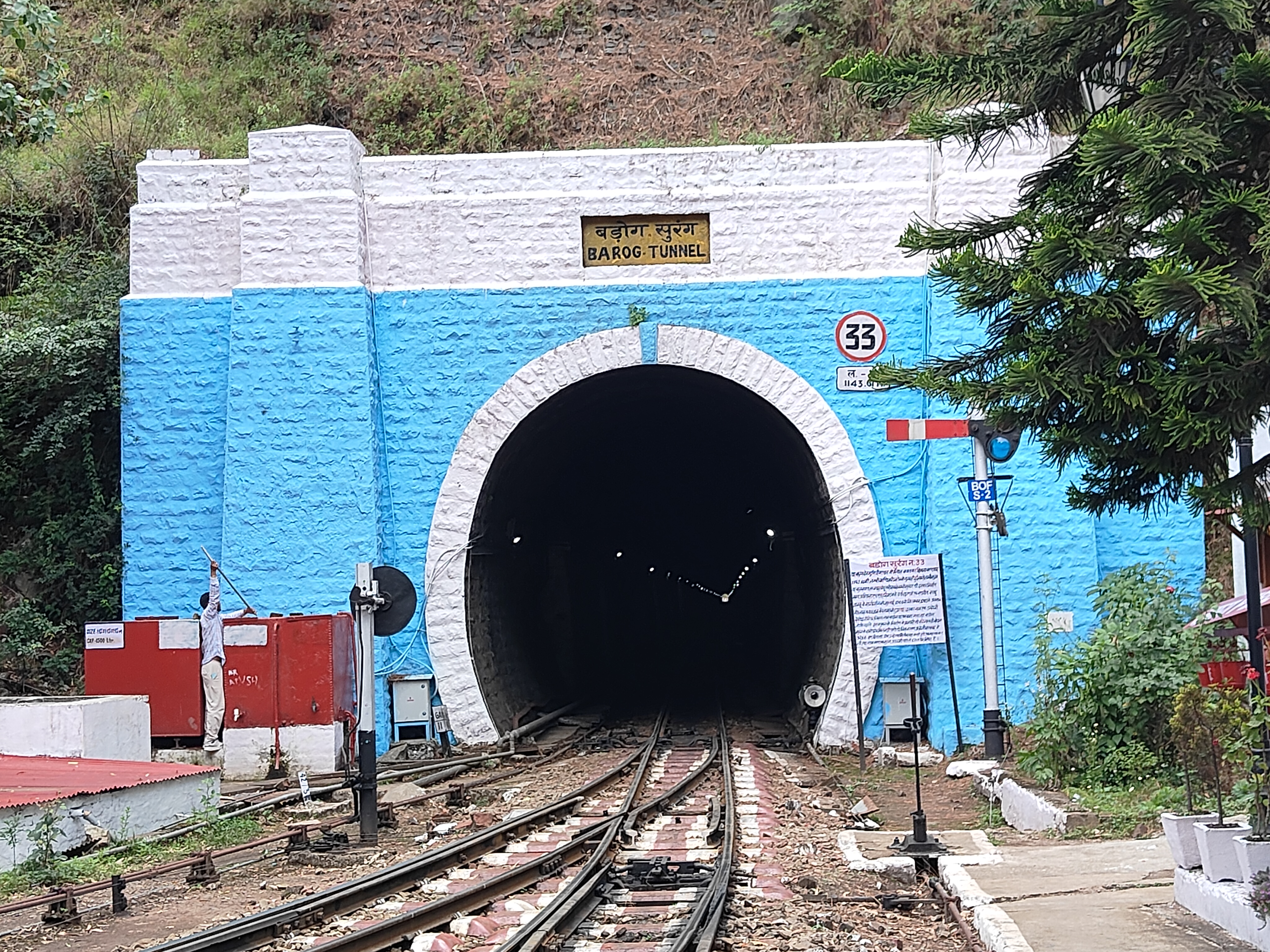
The Fairy-tale connection between the Barog Tunnel, Himachal Pradesh, and Five Go Off to Camp by Enid Blyton
Recently, I had an opportunity to visit the Barog Tunnel in the Solan district of Himachal Pradesh. As I walked through the area, I was reminded of Five Go Off to Camp, the famous adventure novel by Enid Blyton. While the comparison is not exact, the atmosphere of the place instantly brought back memories of the Famous Five’s mysterious ghost train adventure. Quite coincidentally, there were five of us on the trip, our own “unfamous five.”
Our driver dropped us on the highway above the station, and we had to make a steep descent on foot to reach Barog Railway Station. With every step downhill, I felt myself travelling back in time to my childhood, when I had first read Blyton’s novel.
A major part of Five Go Off to Camp revolves around the mystery of a “ghost train” that is said to appear at night and disappear into the hills. The Famous Five initially dismiss the stories as mere superstition, but they eventually discover that the ghost train is linked to a network of abandoned tunnels and a criminal operation. Blyton’s vivid descriptions of the train moving silently through the darkness, the strange lights, and the underground passages make it one of the most atmospheric mysteries in the Famous Five series. The Barog Tunnel, however, bears no direct resemblance to the novel. The tunnel was completed in 1903, whereas the book was first published in 1948.
The Barog Tunnel, officially known as Tunnel No. 33, is one of India’s most remarkable engineering landmarks. Situated near Barog on the Kalka–Shimla railway line, it is the longest tunnel on this famous mountain railway. Apart from being an engineering marvel, it is also associated with one of India’s best-known railway legends.
During the late nineteenth century, the British government decided to construct a railway linking Kalka with Shimla, then the summer capital of British India. The line had to pass through the steep and rugged Shivalik Hills, presenting enormous engineering challenges. The route required more than a hundred tunnels, hundreds of bridges, and numerous sharp curves. Construction began in 1900 and demanded exceptional engineering skill and perseverance.
A British railway engineer, popularly known as Colonel Barog, was entrusted with constructing one of the longest tunnels on the route. To save time, he adopted a standard engineering method by excavating tunnels simultaneously from both ends of the mountain, expecting the two sections to meet precisely in the middle.
This technique required extremely accurate calculations. Unfortunately, an error occurred during the survey or alignment. As the excavation progressed, it became evident that the two ends would not meet correctly. The mistake meant that a substantial amount of work would have to be abandoned.
The failed alignment embarrassed the British administration. According to the popular account, Colonel Barog was officially reprimanded and fined one rupee, a symbolic rather than a financial punishment. However, for an engineer of his standing, the public humiliation proved deeply distressing.
Unable to bear the disgrace, he reportedly walked into the surrounding hills with his dog and took his own life by shooting himself. He was buried near the unfinished tunnel. Over time, the nearby settlement and railway station came to be known as Barog in his memory.
Modern historians, however, have questioned several aspects of this well-known story.
Research based on British engineering journals and newspapers from the early twentieth century suggests that the legend may have been embellished over time. Contemporary records describe difficult geological conditions, underground springs, and slow construction progress, but they do not clearly mention a disastrous surveying error or a major delay caused by incorrect alignment. Even more interestingly, historical documents indicate that the name “Barog” was already in use for the locality before the tunnel was completed, suggesting that the town may not have been named after the engineer. Thus, while the tragedy of Colonel Barog has become an enduring part of local folklore, some details remain historically uncertain.
Following the failure, the project continued under the supervision of Chief Engineer H. S. Harrington. Local tradition holds that a village guide named Baba Bhalku helped the engineers identify the correct alignment through the mountains. Whether through remarkable local knowledge or extraordinary intuition, Baba Bhalku became closely associated with the successful completion of the railway. His contribution continues to be honoured today, and the railway museum in Shimla bears his name.
A new alignment was selected, and work resumed. The present Tunnel No. 33 was completed in 1903. It measures 1,143.61 metres (3,752 feet), making it the longest tunnel on the Kalka–Shimla Railway. Trains take approximately two and a half to three minutes to pass through it. In 2008, the railway was designated a UNESCO World Heritage Site as part of the Mountain Railways of India.
No account of Barog is complete without mentioning its famous ghost legend. Local residents believe that Colonel Barog’s spirit still wanders near the abandoned tunnel. Some visitors claim to have heard footsteps or whispers, while others report seeing a solitary figure dressed in old-fashioned clothes. Interestingly, many describe the ghost as friendly rather than frightening.
There is, however, no scientific evidence to support these paranormal claims. The tunnel’s haunted reputation survives largely through folklore, travel stories, and popular media rather than verified historical or scientific evidence.
The old abandoned tunnel, where the original excavation is said to have failed, still exists in the nearby forest. It has become a popular destination for trekkers, photographers, and history enthusiasts interested in the legend surrounding Colonel Barog.
Today, Barog is a peaceful hill station surrounded by pine and oak forests. The toy train continues to stop at Barog station, and travellers enjoy the dramatic experience of emerging from the long tunnel into the beautiful valley beyond. The station was once well known for serving leisurely lunches to British officials travelling between Kalka and Shimla.
The story of the Barog Tunnel remains memorable because it brings together several compelling themes: human ambition and engineering excellence, the consequences of a single mistake, the pressures of professional honour, the importance of local knowledge represented by Baba Bhalku, and the fascinating blend of history with folklore and ghost stories.
Whether every detail of Colonel Barog’s life is historically accurate or partly legendary, the Barog Tunnel remains one of India’s most remarkable railway monuments. It stands not only as an outstanding engineering achievement but also as a reminder that history often becomes richer when facts and folklore travel together.
Written and posted by Kamlesh Tripathi
Author, Poet, & Columnist
*
https://kamleshsujata.wordpress.com
*
Like it and Share it
*
Shravan Charity Mission is an NGO that works for poor children suffering from life-threatening diseases, especially cancer. Our posts are meant for our readers, including children and adults, and have a huge variety of content. We also accept donations for our mission. Should you wish to donate to the cause of cancer? The bank details are given below:
NAME OF ACCOUNT: SHRAVAN CHARITY MISSION
Account no: 680510110004635 (BANK OF INDIA)
IFSC code: BKID0006805***

