Copyright@shravancharitymission

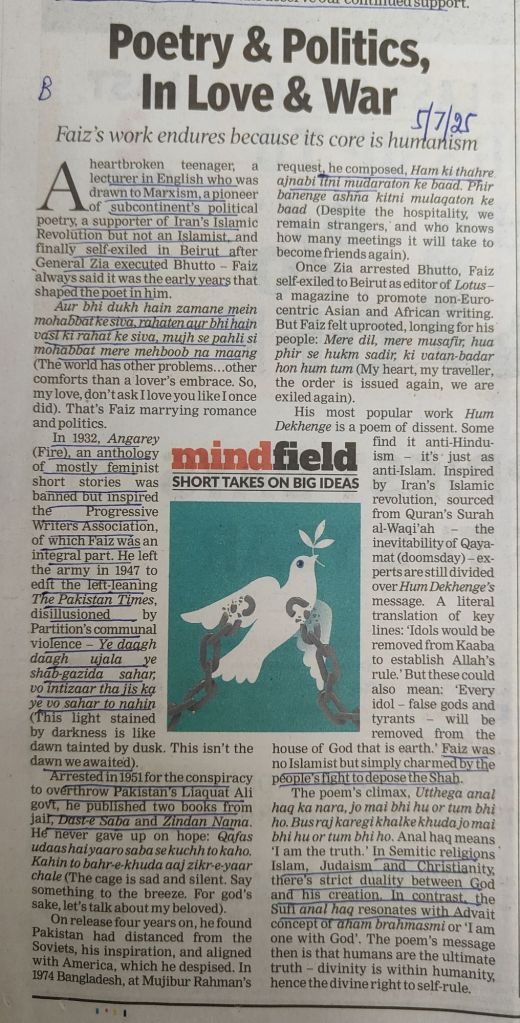
FAIZ’S WORK ENDURES BECAUSE ITS CORE IS HUMANISM
A heartbroken teenager, a lecturer in English who was drawn to Marxism, a pioneer of the subcontinent’s political poetry, a supporter of Iran’s Islamic Revolution but not an Islamist, and finally self-exiled in Beirut after General Zia executed Bhutto – Faiz always said it was the early years that shaped the poet in him.
Aur bhi dukh hain zamane mein mohabbat ke siva, rahaten aur bhi hain vasi ki rahat ke siva, mujh se pahli si mohabbat mere mehboob na maang (The world has other problems… other comforts than a lover’s embrace. So, my love, don’t ask I love you like I once did). That’s Faiz marrying romance and politics.
In 1932, Angarey (Fire), an anthology of mostly feminist short stories, was banned but inspired the Progressive Writers Association, of which Faiz was an integral part. He left the army in 1947 to edit the left-leaning The Pakistan Times, disillusioned by Partition’s communal violence — Ye daagh daagh ujala ye shab-gazida sahar, vo intezaar tha jis ka ye vo sahar to nahin (This light stained by darkness is like dawn tainted by dusk. This isn’t the dawn we awaited).
Arrested in 1951for the conspiracy to overthrow Pakistan’s Liaquat Ali govt, he published two books from jail. Dast-e Saba and Zindan Nama. He never gave up on hope: Qafas udaas hai yaaro saba se kuchh to kaho. Kahin to bahr-e-khuda aaj zikr-e-yaar chale (The cage is sad and silent. Say something to the breeze. For god’s sake, let’s talk about my beloved).
On release four years on, he found Pakistan had distanced itself from the Soviets, his inspiration, and aligned with America, which he despised. In 1974, Bangladesh, at Mujibur Rahman’s request, he composed, Ham ki thahre ajnabi itni mudaraton ke baad. Phir banege ashna kitni mulaqaton ke baad (Despite the hospitality, we remain strangers, and who knows how many meetings it will take to become friends again).
Once Zia arrested Bhutto, Faiz self-exiled to Beirut as editor of Lotus- a magazine to promote non-Euro-centric Asian and African writing. But Faiz felt uprooted, longing for his people: Mere dil, mere musafir, hua phir se hukum sadir, ki vatan-badar hon hum tum (My heart, my traveller, the order is issued again, we are exiled again).
His most popular work, Hum Dekhenge, is a poem of dissent. Some find it anti-Hinduism — it’s just as anti-Islam. Inspired by Iran’s Islamic revolution, sourced from the Quran’s Surah al-Waqi’ah – the inevitability of Qayamat (doomsday)- experts are still divided over Hum Dekhenge’s message. A literal translation of key lines: ‘Idols would be removed from Kaaba to establish Allah’s rule.’ But these could also mean: Every idol – false gods and tyrants – will be removed from the house of God that is earth.’ Faiz was no Islamist but simply charmed by the people’s fight to depose the Shah.
The poem’s climax, Utthega anal haq ka nara, jo mai bhi hu or tum bhi ho. Bus raj karegi khalke khuda jo mai bhi hu or tum bhi ho. Anal haq means ‘I am the truth.’ In Semitic religions, Islam, Judaism and Christianity, there’s strict duality between God and his creation. In contrast, the Sufi anal haq resonates with the Advait concept of aham brahmasmi or ‘I am one with God.’ The poem’s message then is that humans are the ultimate truth — divinity is within humanity, hence the divine right to self-rule.
(TIMES OF INDIA 5.7.25)
Posted by Kamlesh Tripathi
Author, Poet, & Columnist
*
https://kamleshsujata.wordpress.com
*
Like it and Share it
*
Shravan Charity Mission is an NGO that works for poor children suffering from life-threatening diseases, especially cancer. Our posts are meant for our readers, including children and adults, and have a huge variety of content. We also accept donations for our mission. Should you wish to donate to the cause of cancer? The bank details are given below:
NAME OF ACCOUNT: SHRAVAN CHARITY MISSION
Account no: 680510110004635 (BANK OF INDIA)
IFSC code: BKID0006805
***
 Shravan charity mission