To quote Mark Antony in Shakespeare’s play Julius Caesar, “ Friends, Romans, countrymen, lend me your ears;/I come to bury Caesar, not to praise him./The evil that men do lives after them; The good is oft interred with their bones;/So let it be with Caesar. The noble Brutus/Hath told you Caesar was ambitious./If it were so, it was a grievous fault,/And grievously hath Caesar answer’d it”.
Ambition is highly incendiary. It can illuminate the path to greatness or burn everything in its heat. In Shakespeare’s Julius Caesar, Caesar’s ambition is both political and personal. He is neither a clear villain nor an innocent victim. His rise to power threatens to jeopardise the balance of the Roman Republic. To Brutus and the conspirators, Caesar’s growing influence signals a danger to Rome’s liberty and its soul. They believe that if Caesar’s ambition is left unchecked, it would transform a free republic into a monarchy. But as per Shakespeare, Caesar’s ambition is as much perceived as proven. He refuses the crown three times. He speaks for the people and wins their loyalty. His “fault,” perhaps, lies not in the naked greed for power but in his pride. “Not that I loved Caesar less, but that I loved Rome more,” says Brutus. Ambition must be punished before it turns into tyranny. But Shakespeare refuses to make the judgment easy. Caesar’s ambition is not that of a usurper. He is neither the villain nor the saint of the play.
In Indian mythology, we find numerous characters whose fates mirror that of Caesar’s. Ravana, the mighty king of Lanka, was a scholar, warrior, and devotee of Lord Shiva. Yet his depraved ambition to be invincible and possess Sita led him to his downfall. As a result, his strength turned to self-destruction. Finally, it wasn’t Rama’s arrows alone that destroyed him, but his own unchecked ambition. The same holds for Duryodhana in the Mahabharata. His craving to rule Hastinapura mirrors Caesar’s political hunger. He could not bear to see the Pandavas prosper. His refusal to grant even “five villages” led to the catastrophic Kurukshetra war. Like Caesar, Duryodhana believed power to be his birthright.
Karna’s story offers a fine parallel to Caesar’s personal ambition. Born into secrecy and raised in obscurity, Karna’s entire life is driven by a longing for recognition and respect. His ambition is noble. He wishes to prove his worth against Arjuna and rise above the stigma of his birth. Similarly, Caesar’s early life is marked by political struggle and a fierce determination to climb the ranks of Roman power. Yet both men get entangled in loyalties that blur moral boundaries. Karna’s devotion to Duryodhana, like Caesar’s trust in Antony and others, leads him to defend causes that conflict with dharma. Ambition without a noble cause, Shakespeare and Vyasa both suggest, can make even noble men pawns in larger tragedies.
Hiranyakashipu’s ambition to rule the three worlds and attain immortality resembles Caesar’s own belief that he was beyond human intervention, as he proudly declares himself “as constant as the Northern Star.” Caesar’s rise disrupts the harmony of the Roman Republic. Their arrogance invites downfall—one at the hands of Narasimha, the other at the daggers of Brutus & co.
Similarly, Mahishasura, who sought supremacy over the gods, embodies unrestrained ambition that disturbs the cosmic balance. He, too, is destroyed by the divine feminine force, Goddess Durga. In every tale, ambition that crosses moral or spiritual boundaries brings destruction, not only to the ambitious themselves but to the world around them. Narasimha’s claws and the daggers of Brutus are but instruments of the same law: that unchecked ambition invites its own end.
Mythology offers a counterpoint in the case of King Mahabali. Mahabali desired to rule heaven, earth, and the underworld. But when faced with Lord Vishnu in his Vamana avatar, he chose humility over defiance, surrendering his kingdom and ego. Unlike Ravana or Duryodhana, Mahabali’s humility redeemed him, earning divine grace and immortality in memory. Here lies a profound contrast with Caesar: where Mahabali bows, Caesar refuses to yield. Shakespeare’s Caesar, standing tall against the soothsayer’s warning, “Beware the Ides of March”, becomes the very image of a man too proud to listen, too ambitious to step back.
Ambition, then, is the fire that can both create and consume. It is political when it seeks power, personal when it seeks recognition, and tragic when it forgets restraint. From Caesar to Ravana, from Duryodhana to Macbeth, the pattern endures; the greater the climb, the greater the fall. As Shakespeare and the epics remind us, ambition is not inherently evil. It becomes dangerous when it blinds the heart and mind. To be ambitious is human. To be over-ambitious is to challenge the divine. The lesson of Caesar and his mythological counterparts is eternal. Ambition must be guided by wisdom, or it becomes a double-edged sword. One that wins glory in one stroke and brings ruin in the next.
From Caesar’s Rome to Ravana’s Lanka, from Duryodhana’s Hastinapura to Macbeth’s Scotland, the story remains unchanged. Ambition is both the sculptor and the destroyer of greatness. Ambition is divine when guided by purpose, but deadly when driven by ego. It can build empires, yet when it loses sight of humility, it consumes all that it touches.
So, is being ambitious a double-edged sword? Indeed, it is. One edge gleams with glory. The other drips with ruin, the cost of believing oneself to be larger than the truth. Caesar’s blood on the steps of the Senate, Ravana’s fall in battle, Duryodhana’s broken crown, and Karna’s dying smile, all remind us that the line between greatness and downfall is as thin as a sword’s edge.
Shravan Charity Mission is an NGO that works for poor children suffering from life-threatening diseases, especially cancer. Our posts are designed for our readers, including children and adults, and feature a diverse range of content. We also accept donations for our mission. Should you wish to donate to the cause of cancer? The bank details are given below:
There are two things that a man cannot do even if he devotes all his life to it. The first is he cannot read all the literature available in the world during his lifetime. The second is he cannot behold all the wonders on earth created by God Almighty. But yes he can visit many of them if he sincerely endeavours to. We attempted to do that.
On 13th August 2023, we left on a group tour of Europe. Our tour operator was Kesari Tours, Mumbai. Our first take-off was an early morning three-hour Indigo Flight from Mumbai to Doha. It landed in Doha the capital of Qatar, where we had a two-hour halt. Thereafter, we were on a Qatar Airways 7-hour flight to London.
We landed at Heathrow London, Terminal 4 at around 2.30 PM London time. It took three hours for the group to clear immigration. By the time we were out of the airport, it was 6 PM. We reached our Hotel, Holiday Inn Express Terminal 5, at seven. The check-in was followed by dinner. The day in London appeared longer than Mumbai, say till nine in the evening in August, as a result, one felt as if one had just finished lunch instead of dinner.
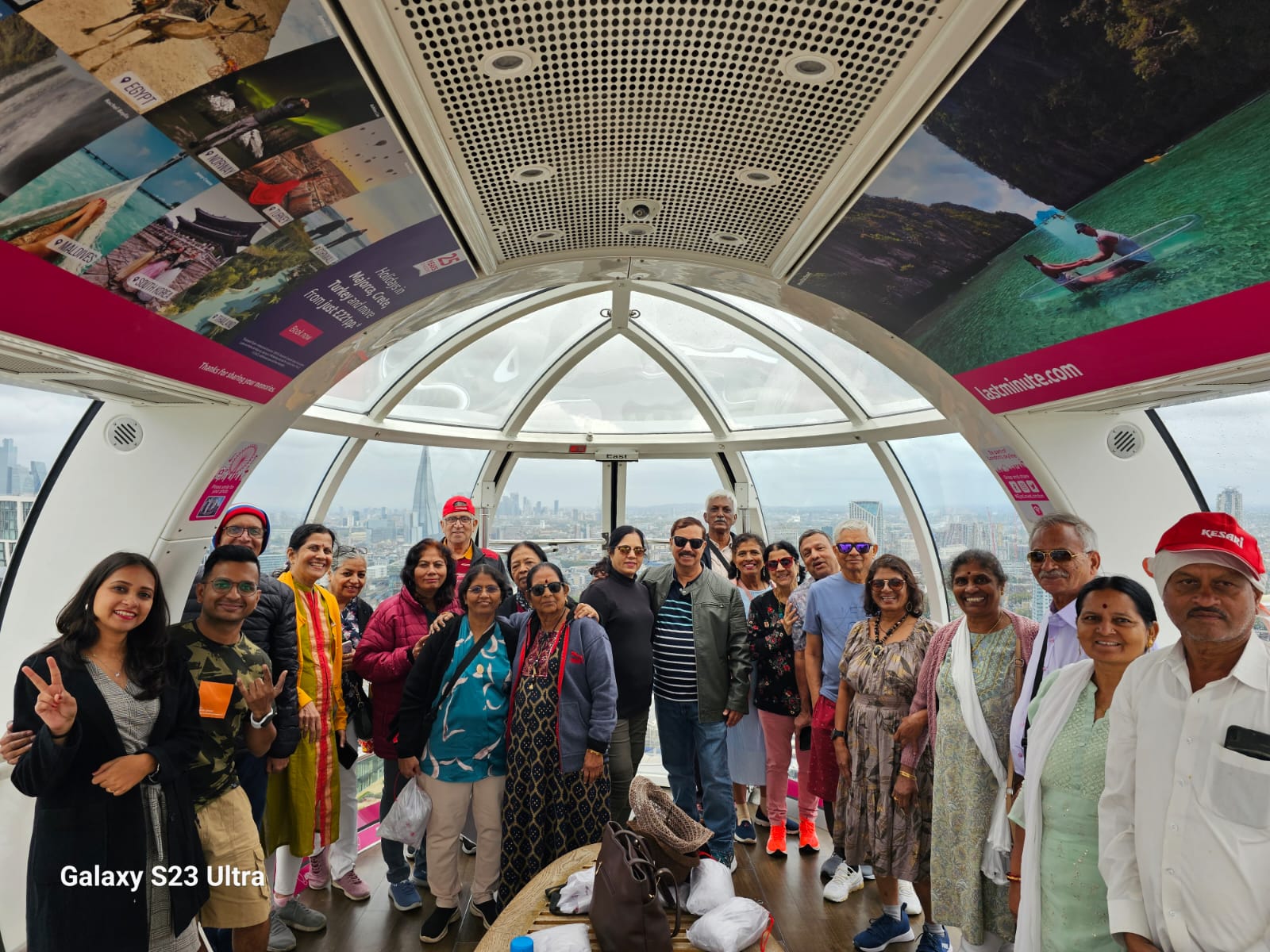
14.8.23: We left for local London sightseeing after an English breakfast at nine in the morning. We travelled to London City Centre crossing zone 3, 2 and 1. Our local travel guide was Sari and coach driver was Sam. We visited the Natural History Museum followed by Victoria and Albert Museum. There were several unique and brick-laden houses on the way that gave a grand look to the city. We passed through the Piccadilly Circle, Hyde Park, Hyde Corner, the statue of the Duke of Wellington straddled on his horse, the Fountain of Opera, Trafalgar Square—Nelson’s Column and its four lions considered zero miles in UK where plenty of Bollywood movies have been shot. Soon after we saw the ‘change of guard ceremony’ at 11.30 in Buckingham Palace which is held every alternate day. We were lucky to be there on the right day which was Monday. It’s an old royal tradition and we were able to video shoot the ceremony. The royal family guards change their shifts under a proper ceremony along with the marching band. The next on the sightseeing list were the Big Ben, Westminster Abbey, Parliament Square and 10 Downing Street. When I crossed the Thames River it reminded me of the old classic song, ‘Scarborough Fair’. The ‘London Eye’ was fascinating. We then saw the symbol of the two dragons indicating you’re entering London. The actual London city is colloquially called the Square Mile. It is 2.90 km square, in area.
LONDON EYE
The London Eye gives a panoramic view of the city of London. It has 32 capsules. It takes 32 minutes for a circle with 32 people, reminding you of the 32 boroughs of London. One capsule represents one borough. The next to see was the Phantom of the Opera, the tower bridge on the left of London Bridge. We drove past the London Bridge and the fire monument of the 16th century. Our lunch was at the Bangalore Express Restaurant. This was followed by a long stroll and shopping in Oxford Street, followed by dinner at the Hot Plate Restaurant and then we returned to our hotel.
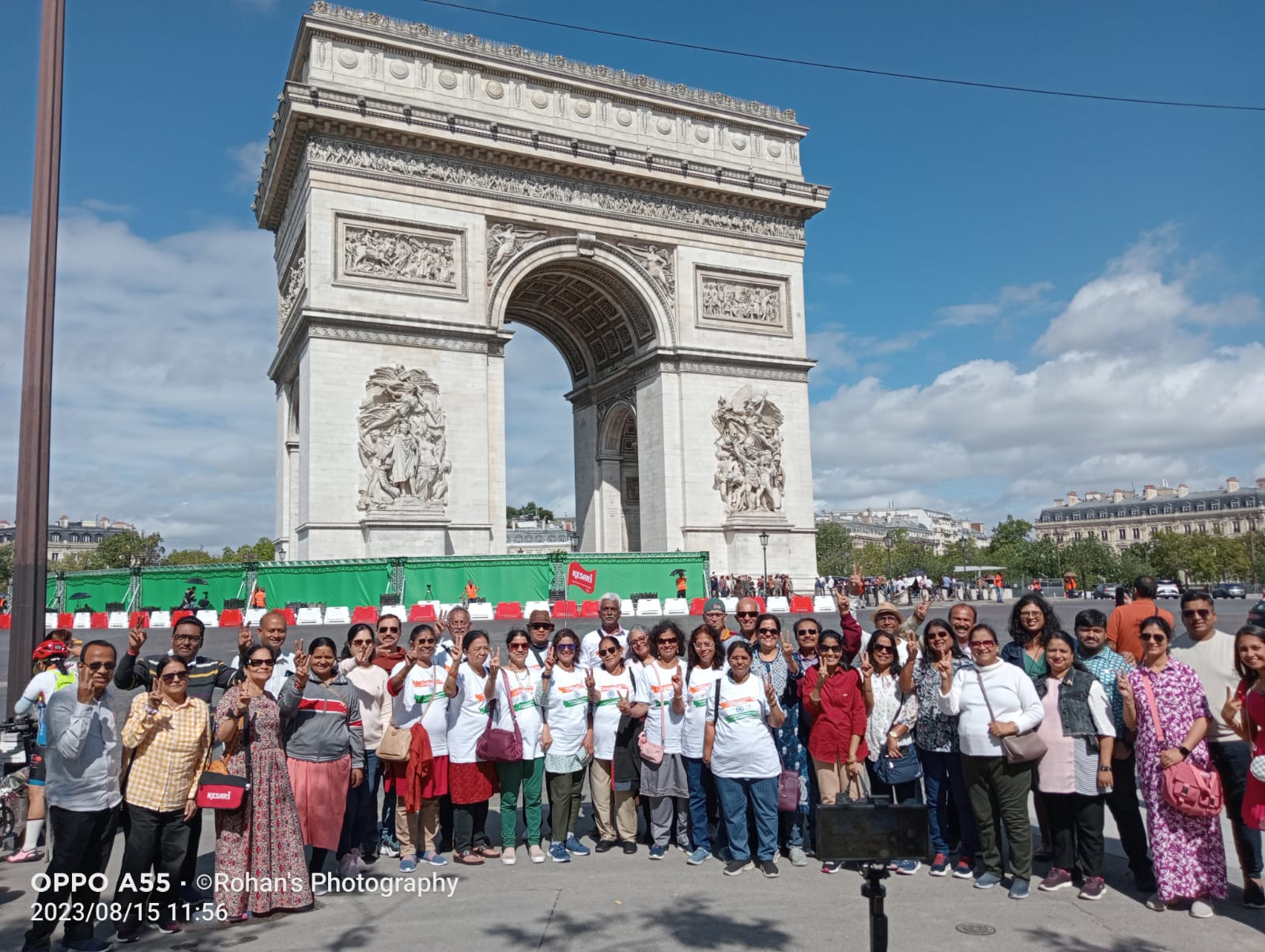
15.8.23: On Independence Day we were up at three in the morning. The need was to catch the famous Eurostar train to Paris and Brussels from St. Pancras International Station, London. The train was at 7.01 AM. We left the hotel at 4.30 in a coach to be at the station by five. The security check at the railway station was quite tedious because of the heavy luggage that we were carrying. After the security, one technically leaves the territory of the U.K. and enters Europe on a Schengen visa. Twenty minutes before departure we were informed about our gate number. We sat in bogies 12 and 13 after walking past gate number 10. Soon, the Eurostar train number 9004 to Paris, left platform 10 from St Pancras Railway Station. After a point, it entered Europe leaving behind the U.K. It took 2 hours and 20 minutes to reach Paris. We were there at 10.20 AM which was exactly two hours and twenty minutes of travel time, but going by the clock it was three hours and twenty minutes because the continent of Europe is one hour ahead of the U.K. time. Our immigration process was held in London station itself. There are tunnels under the English Channel. The train crosses them in about 15-16 minutes on its way to Paris-Gare-du-Nord railway station in Paris. On the way, we ate breakfast along with hot coffee. The local tour guide in Paris was one Mr Senthil, an expat Indian from Tamilnadu. He started the city tour with a Vannakam—Tamil Namaste. Soon Paris started unfolding in front of our eyes. The tour began with the Opera House and The Greek Church—rich in Greek architecture. Then we saw the Golden Flame and the bridge where Lady Diana died in a car mishap. Then followed the Place De La Concorde Square, Macaline, Shawn Elizey, and the famous Eiffel Tower.
15TH AUGUST 2023, WITH TIRANGA FLAGS NEAR EIFFEL TOWER IN PARIS
We celebrated Independence Day with the Tiranga singing our national anthem in front of the Eiffel Tower. Later we visited Napoleon Bonaparte’s tomb in Les Invalides. Lunch was at ‘Welcome India,’ an Indian restaurant, after which at 2 PM we left for the Eiffel Tower. There was a huge crowd there with several souvenir shops. The names of Jules Verne (the author of Twenty Thousand Leagues Under the Sea) and Victor Hugo (the author of Les Miserables), both French authors, find their names mentioned in many of these shops and even in some public areas in Paris. Just as Sir Arthur Conan Doyle’s bust is seen in Baker Street, London. Do you recall the mention of Baker Street in the Sherlock Homes novels?
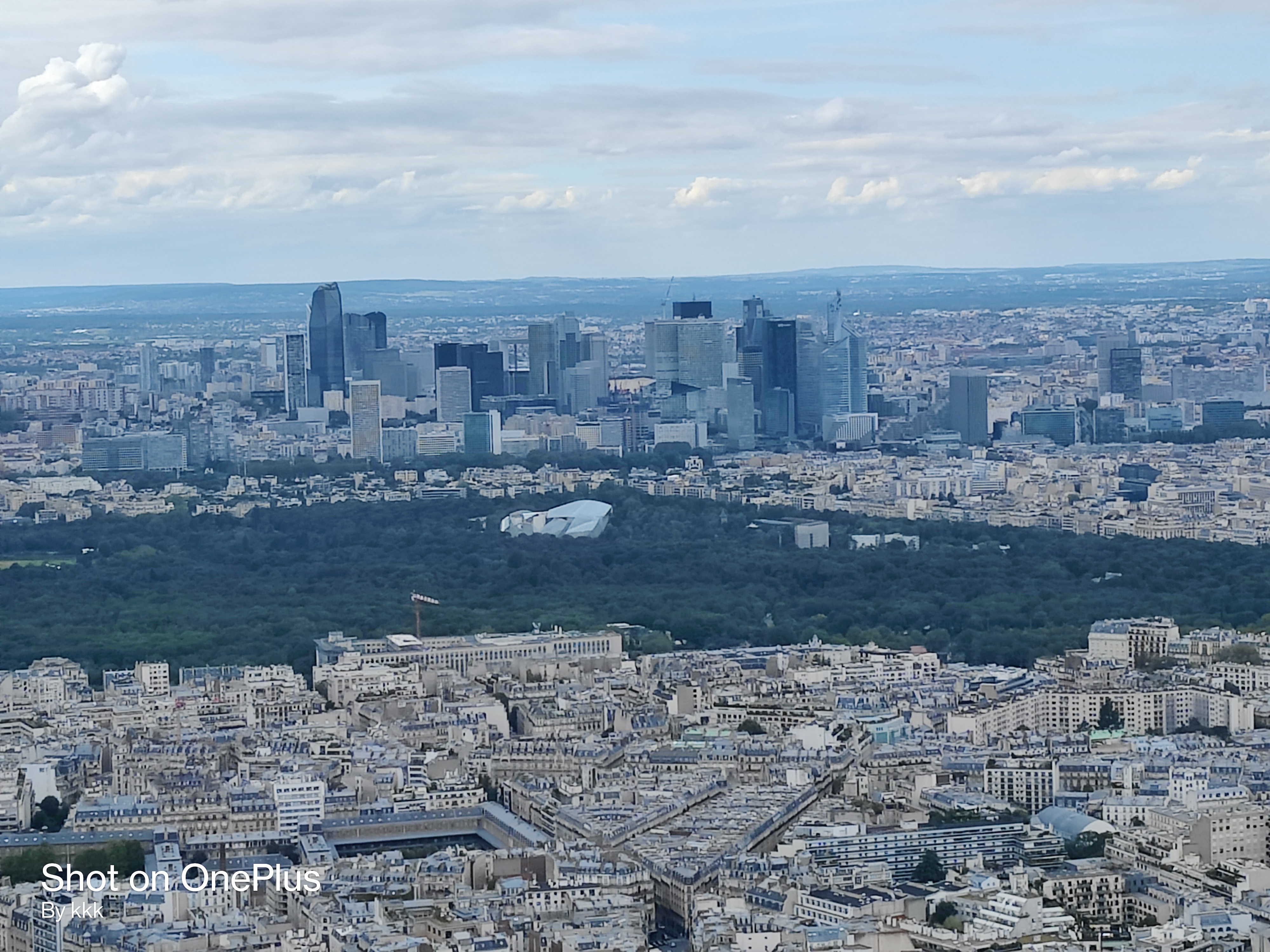
It took us two hours to get across the security gate alone and reach the summit level of the Eiffel Tower. The aerial view of Paris city from there was gorgeous. The summit level was earlier closed. Later they opened it. We were lucky to get the tickets for it. There is a Champagne bar there where we had a drink. The Eiffel Tower has three floors. The first level, the second level, and the summit level. The pillar elevators and the stairs take you to the first and second levels. To reach the top of the Tower from the second-floor platform, one needed to locate the separate elevator meant for it. In the same sequence, one can come down. After beholding the Eiffel Tower to our fill, we undertook a river cruise in the Seine River which was breathtaking.
THE CITY OF PARIS FROM EIFFEL TOWER SUMMIT
Our dinner was at Mewar Restaurant at 7 PM and by eight, we were back in our hotel, Novotel. The roads in Europe were quite open without traffic jams so one could accurately calculate the travel time. After an hour of free time in the hotel, we drove down to the main Paris city which included ‘The Champs-Elysees’, the main street of Paris that in some ways resembled the ‘Kartavya Path’ in New Delhi where we had a photo session in the glittering lights. After that, we went to the Eiffel Tower again. And wow!! It was an amazing sight to see the entire Tower lit up at eleven in the night. We returned to our hotel at midnight. The 15th of August was the longest day of our tour—from 3 a.m to midnight and from London to Paris.
16.8.23
The next day our coach rolled out of the hotel at 8 AM after a sumptuous continental breakfast. Soon it started negotiating the wide roads. Today, we were to travel from Paris to Brussels the capital of Belgium. Belgium is also the capital of the European Union. From Belgium we were to travel to the Netherlands. We realized the uniqueness of Europe: It was breakfast in France, lunch in Belgium and dinner in the Netherlands. It took three and a half hours from Paris to Brussels. The drive was picturesque with the ongoing green landscape and flowing rivers off and on. There was no honking. The drivers in Europe were disciplined and didn’t drive outside their lane, something that needs to be appreciated. Our coach driver was Michelle who hailed from Italy. All along there were small and big villages, all neatly manicured, and all with a church tower. The landscape was verily verdant with a river or two flowing near Belgium where we had a filling meal at the Wonders Restaurant. Thereafter we visited the city centre called the La Grand Place in Brussels, a beautiful square that houses the Town Hall, the Gilded Age houses and the circular monument. There is an old folktale behind the ‘Mannekin Pis Statue’ … ‘The Peeing Boy Statue’ at the nub of the Square. There was hectic shopping in that inviting market. There were photo-ops too followed by a session of delicious ice cream. At four in the evening, we left for Atomium, and it took us an hour to get there. It was again a photo-op point with a long history. The place houses a huge atom structure with 9 spheres and 21 cubes. It is part of the gate built in 1957 considered an icon of Belgium. After the Atomium, we left for Amsterdam, the Netherlands. We crossed Valenciennes—the France – Belgium – border. Then we crossed Breda which is the Belgium- Netherlands border. But before that, we crossed a small town called Antwerp which is famous for its diamond market. In and around Antwerp we could see many windmills, canals, lakes and village houses. My spouse and I were thrilled to see this exquisite face of nature. In the evening we entered the Netherlands through Hazeldonk. Our dinner was in an Indian Restaurant called ‘Bollywood’ in Amsterdam. By 9 PM we had checked into Amedia Hotel, Amsterdam.
17.8.23
After local sightseeing in Amsterdam, we were to travel to Germany. At 9 AM, we left for Madurodam a miniature park in Amsterdam.
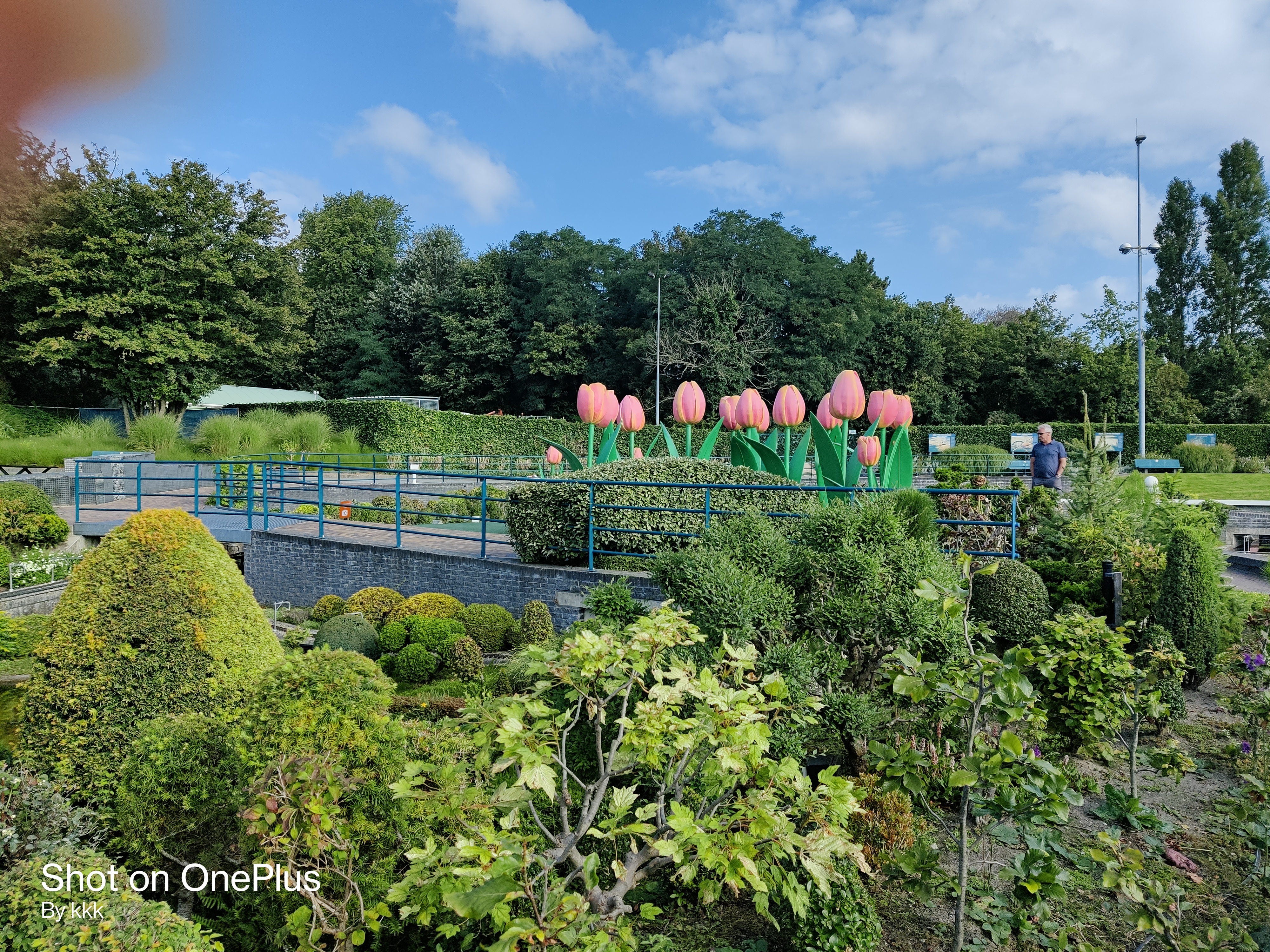
MADURODAM, MINI AMSTERDAM
Madurodam Park is also called mini-Amsterdam. Amsterdam gets its water from the North Sea. It is known as the city of cycles, canals and rivers. It remotely reminds you of Venice. We entered Madurodam Park at 9.45 AM. We were supposed to be there till noon. There were many things to be seen there along with the mind-blowing landscape. Whoever built that park must have been a genius. There was a 3D flight ride in a stationery Dakota Plane with high sound effects. There was so much to photograph there, like the verdant garden with miniature canals, boats, luxury liners and the draw-bridges that lifted when the toy ships passed—a real entertainment for children and even adults. The landscaping was just awesome with miniature hills and forests and the modelling of canals, windmills and rural houses were amazing. The souvenir shops were so well laid and with so much merchandise that it could have tempted anyone to buy in droves. We were to leave the park for lunch but on that day our appointed Guru Restaurant caught fire and we were accommodated in Rangoli Restaurant. It’s so nice to see Indian cuisine reaching the nooks and corners of Europe, but you need to book it in advance because the capacities are still low. The blessing in disguise was that the Rangoli Restaurant was just a 5-minute walk from the Lovers Canal Cruise Station so we were able to meet our schedule. We reached the Restaurant at 1 PM. After a quick bite, we were at the Lovers Canal Cruise for a boat ride at 1.45 PM. The canals reminded me of the last scene (a motorboat chase) of Alistair Maclean’s famous movie ‘The Puppet on a Chain.’ Luckily we had the best of both worlds—the lunch and the canal cruise.
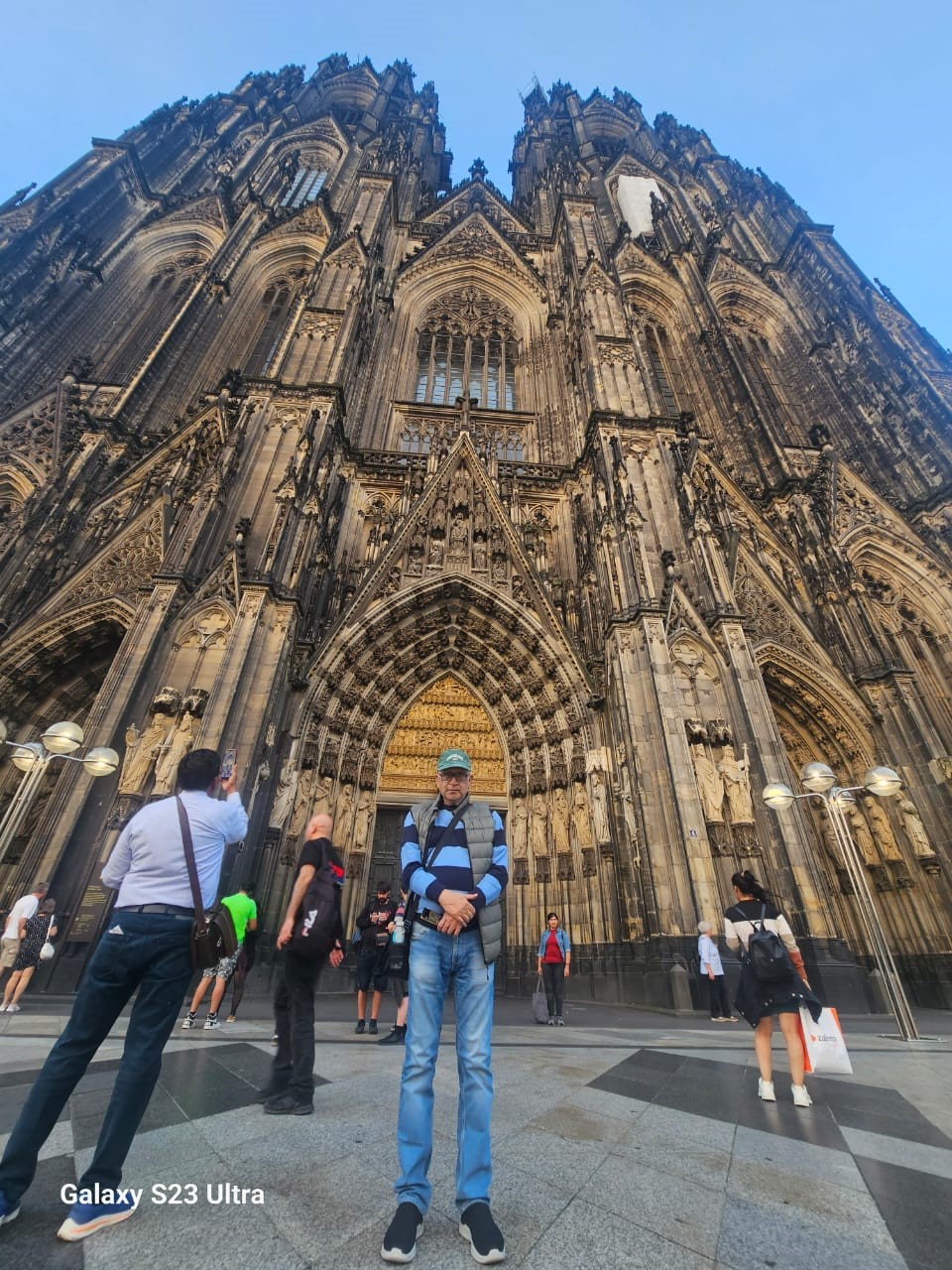
The Cologne Cathedral
In the afternoon we left for Germany. Our destination was Cologne. We were to visit the famous Cologne Cathedral after dinner at the Rangoli Restaurant there, (sunset in Europe is rather late during this time of the year so we could do sightseeing even after dinner). Since it was vacation time in Europe, there wasn’t much traffic either. We reached the restaurant by seven, in 4 hours. After dinner, we took a long walk to reach the Cologne Cathedral. It was still daylight. Cologne Cathedral is a unique landmark of Germany. It has a height of 157 metres and it took 650 years to build this cathedral. We clicked many pictures. Visitors who reached there early were able to enter the Cathedral to have an inside view. After visiting the Cathedral we undertook a 45-minute drive to arrive at the Mercure Hotel, in Bonn, where we checked in for the night. Most European countries are small in land area and one never comes to know when one has crossed over to another country. And while crossing over to another country your passport and visa are not checked.
18.8.23
On 18 August we were to travel across Germany through the Black Forest and reach the Rhine Fall (waterfall) in Switzerland and then to our hotel Seadamm Plaza in Pfaeffikon, Zurich. The drive was through the mystique Bavarian Alps with misty mountains and fast lane observing traffic. The weather was cold and overcast.
We started at eight in the morning, first towards the Black Forest. The Black Forest in the German language is called ‘Schwarzwald’ which is known for the Cuckoo Clock Industry, Cloud Fisheries Industry and the Black Forest Cake. The extended word is ‘Schwarzwalder Kirschtorte’, which translates into ‘Black Forest Cherry Cake’ which is the most famous sweet delicacy of that place. Cuckoo Clocks, Watchmaking, Skiing and Hiking are prime activities of the region. The Black Forest Clock Association includes producers, traders and experts. It provides certification to clock-makers who meet these requirements. All clocks are mechanical and are made by hand in Germany with wood from the Black Forest. During the World War, the area of the Black Forest in Bavaria was destroyed. People had become poor. But by starting these industries people regained their affluence. It became a major tourist centre and with that, the income of local people went up. The first stop of our journey was after 450 km which took us around five-and-a-half hours.
We reached the car park of the Cuckoo Clock factory at about 1.45 PM. The place is known as Titisee Brietnau, where clocks are manufactured. It also manufactures glass toys. We were given a live demonstration of how clocks are made. We also saw a live show of a Cuckoo Clock that squeaks and chimes at two in the afternoon and the dancing dolls come out to dance with their partners. In the deep recesses of Germany, we had a rather sumptuous lunch in great style and variety. We were served dahi vadas, veg pulao, grilled chicken, French fries, cutlets and pastries. The group shopped to its delight and was all for the traditional Cuckoo Clock.
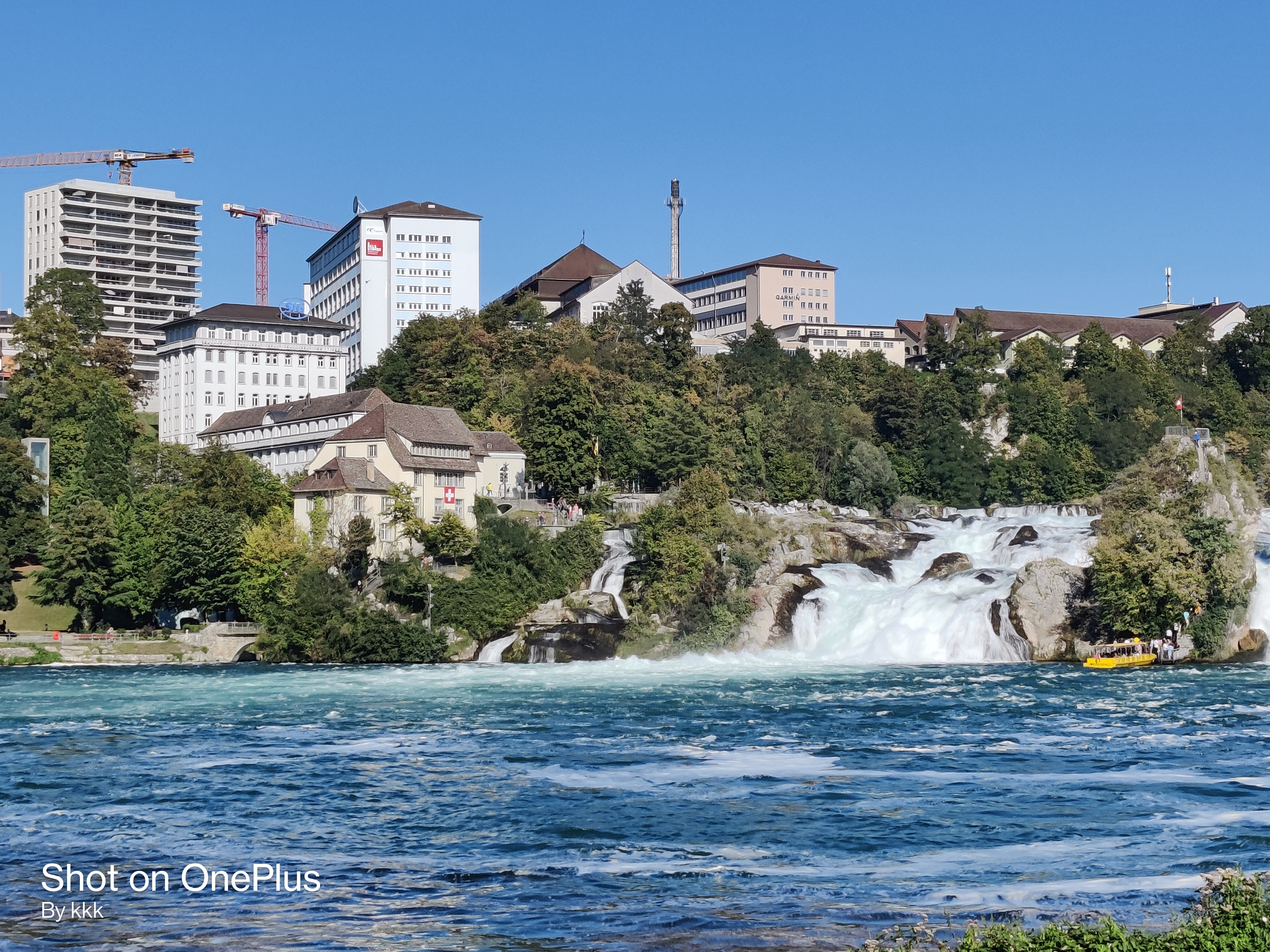
RHINEFALL, SWITZERLAND
At 3 in the afternoon, we left for the Rhine Fall in Switzerland located in the municipality of Neuhausen Am Rhinefall. Earlier there were only rocks and stones there but when the water arrived it turned into a horizontal waterfall. At 5.40 PM we boarded a forty-seater yellow boat. It took us to the rock island at the centre of the fall. We climbed the rock island to have a three-sixty-degree view. And it was amazing. We then returned to the boarding station where we were in for a pleasant surprise as we were served Indian Masala Tea and Mumbai’s famous Vada-Pav right at the heart of the Rhine Fall in Switzerland. After the Rhine Fall, we travelled for two hours to reach our hotel Seddam Plaza in Seddam Centre in Pfäffikon, Switzerland. With that, the long journey across the Black Forest in Germany and the Rhine Fall in Switzerland came to an end.
19.8.23
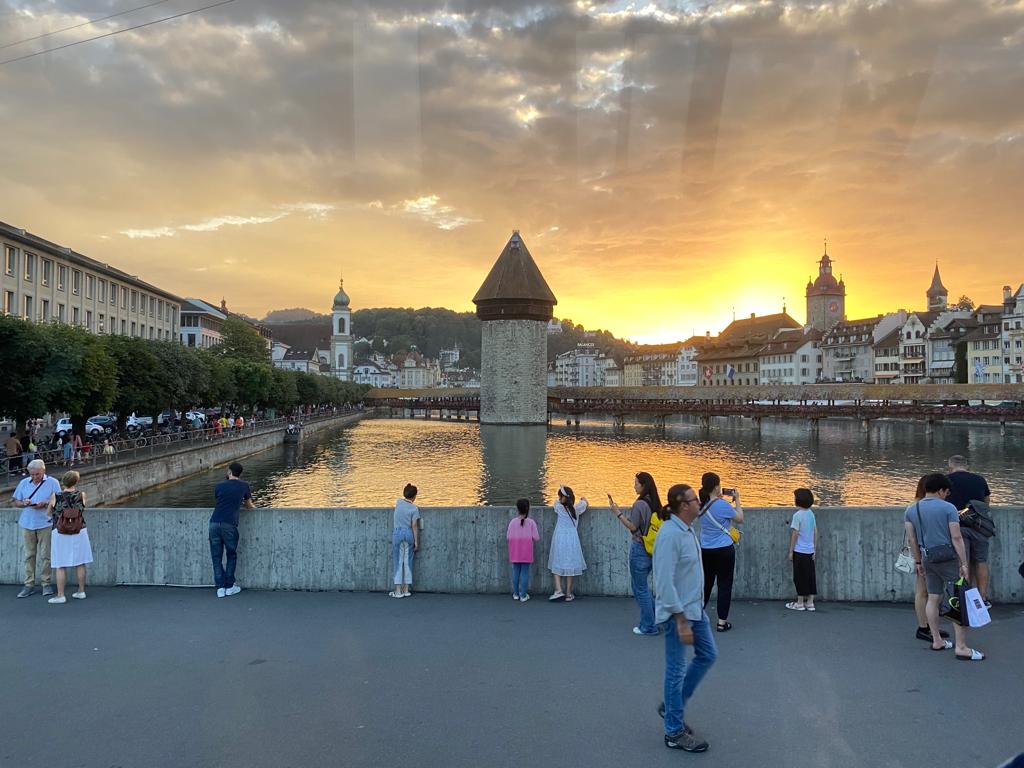
19 August was the highlight day of our tour. We traveled to Mount Titlus in Switzerland. We left our hotel at 8.30 in the morning and arrived in Engelberg, which is the base camp at 10 AM. Engelberg is also called the ‘City of Angels’. From Engelberg, there are cable cars that go right up to Mount Titlis. The journey to the top can be completed in two cable car rides. Engelberg to Stands and Stands to Mount Titlis at an altitude of 10,500 feet. There is a 5-storey building on Mount Titlus. The level 1 of the building has both entry and exit gates. It also has retail shops where we went shopping and had Movenpick ice cream. The weather was unusually warm (signs of global warming). We were roaming in T-shirts without any woollens. The view from the cable car Gondola was just spectacular. We could see some people paragliding from a spot in Mount Titlis. The Titlis Cliff Walk and the Ice Cave were on the first level. We were there till 1.15 PM. Later we came down to Trusbee where we had an Indian meal of Pav-Bhaji, Dhokla, Gajar Halwa, Roti, and Rice. After lunch, we went down to Engelberg and travelled to Lucerne City. In Lucerne, we first went to the Lion Monument dedicated to the Swiss Mercenaries who were killed during the French Revolution by stealth. The sad face of the lion there is dedicated to them. Since the artist who sculpted the Lion monument was not paid his due, he was annoyed, and he cursed them by keeping the lion within the outline of the swine which is considered an abuse.Then we came to Schwanenplatz the busy market area of Lucerne. It is next to the Lucerne Lake which has a sizeable population of ducks on the shore. There was so much to shop starting from Swiss watches, knives, chocolates etc. At 6.30 we were off to a boat cruise with dinner. There we had the pleasure of listening to Swiss folklore and some special instruments. We also chorused Bollywood songs and danced on the upper deck of the boat. After enjoying the sail and dinner we left at eight for our hotel Seedamm Plaza. We were there by nine. It was the climax of our tour: Engelberg, Mount Titlis, Lion Monument, Lucerne Lake and the dinner cruise. We learnt that the government of Switzerland has installed a bust of Indian film producer Yash Chopra in the city of Interlaken for promoting Switzerland in his films.
20.8.23
On 20 August we left Switzerland at 9.30 AM for Wattens, Austria via Vaduz, the capital of Liechtenstein. Liechtenstein is a small country with a tiny population of 35000 people.
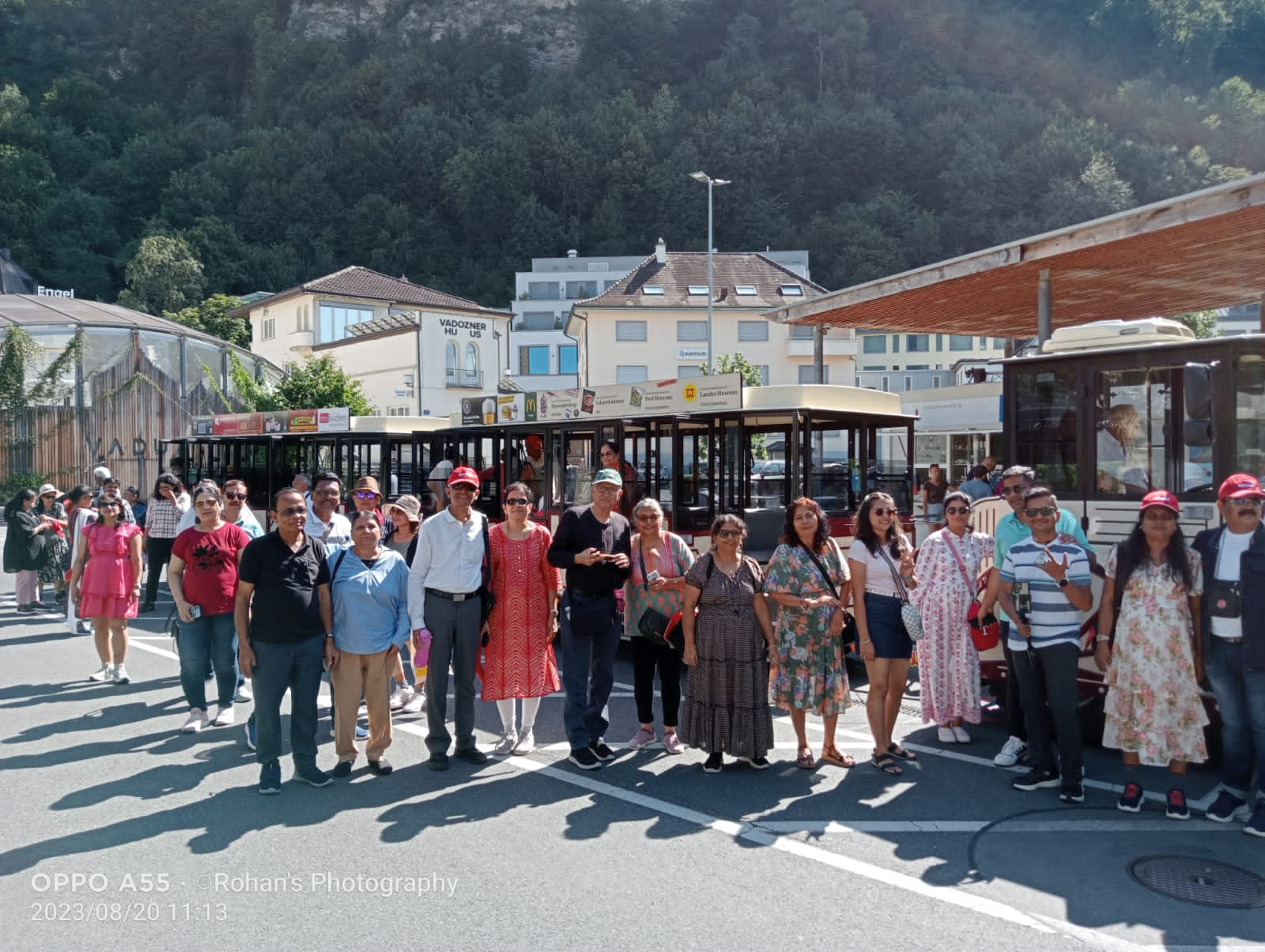
THE GROUP IN LIECHTENSTEIN
They too have their national day on 15 August. We took a guided Mini-Train tour around the city, and can you beat it, the pre-recorded running commentary in that describing the city was in Hindi of all the languages. As Indians, we felt proud. There was lots to buy in Vaaduz like liquor chocolates, garments, coins and souvenirs. There was also a big collection of stamps there for the stamp collectors. We lunched at Schlossle Mahal which is run by a chef from Assam, India. I was thrilled to meet him as I too have my roots in Assam. Moreover, he had studied at Darrang College in Tezpur, Assam. My father was the founder principal of that college in 1945. Indeed the world is small. After the splendid lunch, we departed for Austria which is landlocked with Liechtenstein. The first village that we crossed in Austria was Feldkirch which borders with Liechtenstein. We drove past the Inn River and arrived in Wattens, Austria at 4 PM. Here, we visited the Swarovski Crystal Museum, a wonderful complex. We couldn’t resist the temptation so we bought some crystal glass. Swarovski is a world-renowned brand that manufactures crystal glass. They also have showrooms in India. At 6 in the evening, we left for Innsbruck where we had a walking tour that took us to the Golden Roof, St. Jacob Dome, Inn River and Maria-Theresien Street. We clicked some pictures there. At 7.15 PM we drove to the mountain area—the top of the hill called Axams where we stayed at the Olympia Hotel which is a ski resort and where we had a filling continental dinner. In the evening there was a casual discussion on Mozart who hails from Austria. Recapping … on the 20th, we had breakfast in Switzerland, lunch in Liechtenstein and dinner in Austria.
WATTENS, AUSTRIA
21.8.23
We travelled from Austria to Italy (from Innsbruck in Austria to Venice in Italy). It was a long drive. We left at 7.30 AM to arrive at the designated restaurant for lunch by 1.15 in the afternoon. Punctuality is very important in Europe. We reached the restaurant exactly at 1 PM. The restaurant’s name was Bombay Spice. On the way, we crossed Brenner-Pass over the Alps which is the border between Austria and Italy. We drove through the Alps and finally arrived in Trento. There was a 45-minute halt there after which the Alps were left behind. The landscape re-styled after that. We crossed the city of Verona which is the village of Romeo and Juliet in William Shakespeare’s play. Post Verona, we reached Padua which is an industrial zone. We were to return here for our night halt. After Padua, there is the town of Mestre. We had lunch there in the restaurant called Bombay Spice after obtaining a permit from the checkpoint. Soon after, we left for Tronchetto in Venice where a Vaporetto boat was waiting to take us to St. Marks Island. The temperature was 39 degrees, hot and humid but the group negotiated the weather quite well. After arriving at St. Mark Island we started our walking tour. We went past the Bridge of Sighs, the Canal Grande, the Rialto Bridge, Piazzo San Marco, Santa Maria, Murano, Dodge’s Palace, St Mark’s Square, St. Mark’s Basilica, St. Mark’s Cathedral and a few more spots, all tourist attractions. In our free time there we did hectic photography and souvenir shopping. We then proceeded to Danieli from where we took the Gondola ride for about half an hour. Five people sat in one Gondola. Following that we had Gelato Icecream, and returned to Tronchetto in the same boat by six and then drove down to our hotel – 4 Points by Sheraton in Padua. The dinner was at eight. It came from the Rangoli restaurant in Padua. After dinner, we retired for the day.
22.8.23
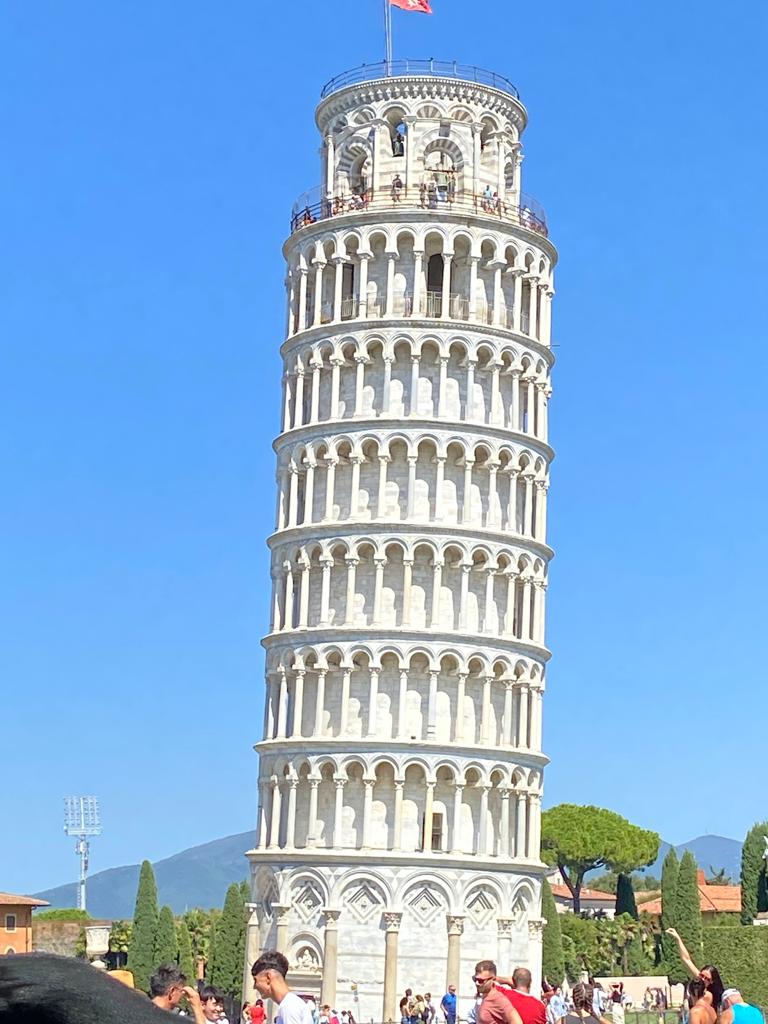
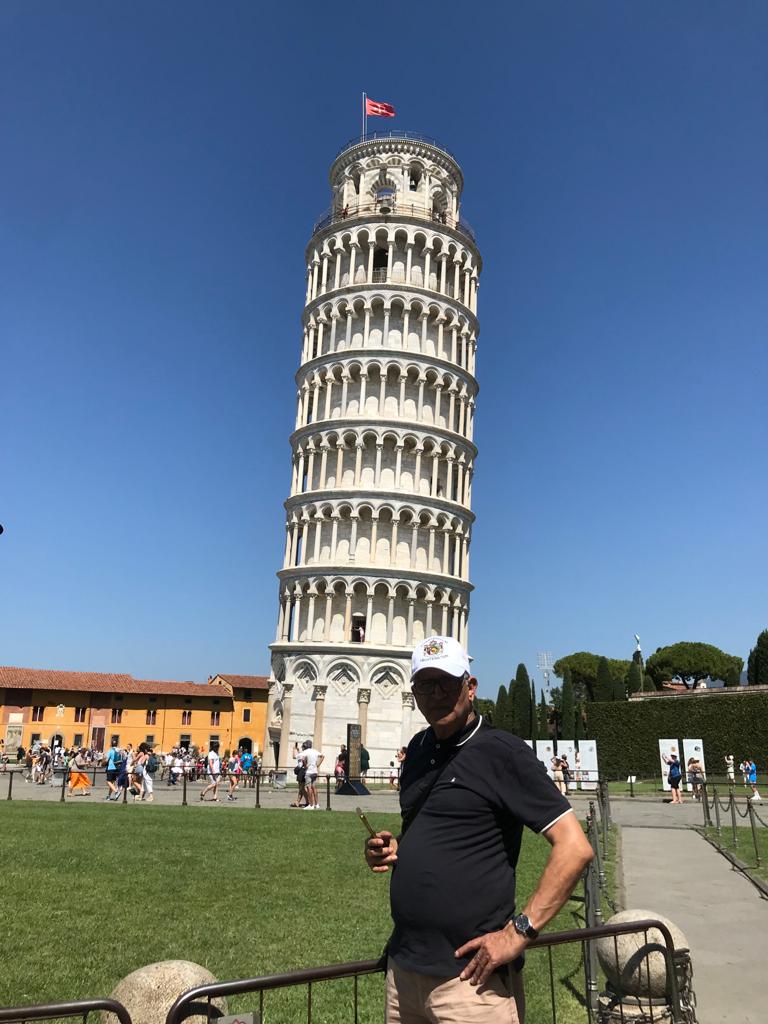
THE LEANING TOWER OF PISA
Today, we were to travel from Padua to Pisa and then to Aritzo, the central part of Italy. It was a relaxed day. We left Padua at nine in the morning and reached Pisa at 1 PM. Pisa is famously known as the city of the Italian astronomer, Galileo Galilei. He was born there. We had lunch at Rajasthan Restaurant in the vicinity. Thereafter we explored the sight: The Square of Miracles which comprises the Leaning Tower of Pisa, the Baptistery, the Cathedral, the Campanile and the Camposanto or Cemetery. We clicked pictures galore of The Leaning Tower in a particular manner as told by Rohan our tour guide. We shopped for souvenirs, had tea, coffee and snacks and then took the Mini-Train back to the parking area where our vehicle awaited us.
THE LEANNG TOWER OF PISA–KAMLESH TRIPATHI
Soon we left for our onward destination, Aritzo. In two hours we were there. We checked into Hotel Aritzo A-Point and called it a day.
23.8.23
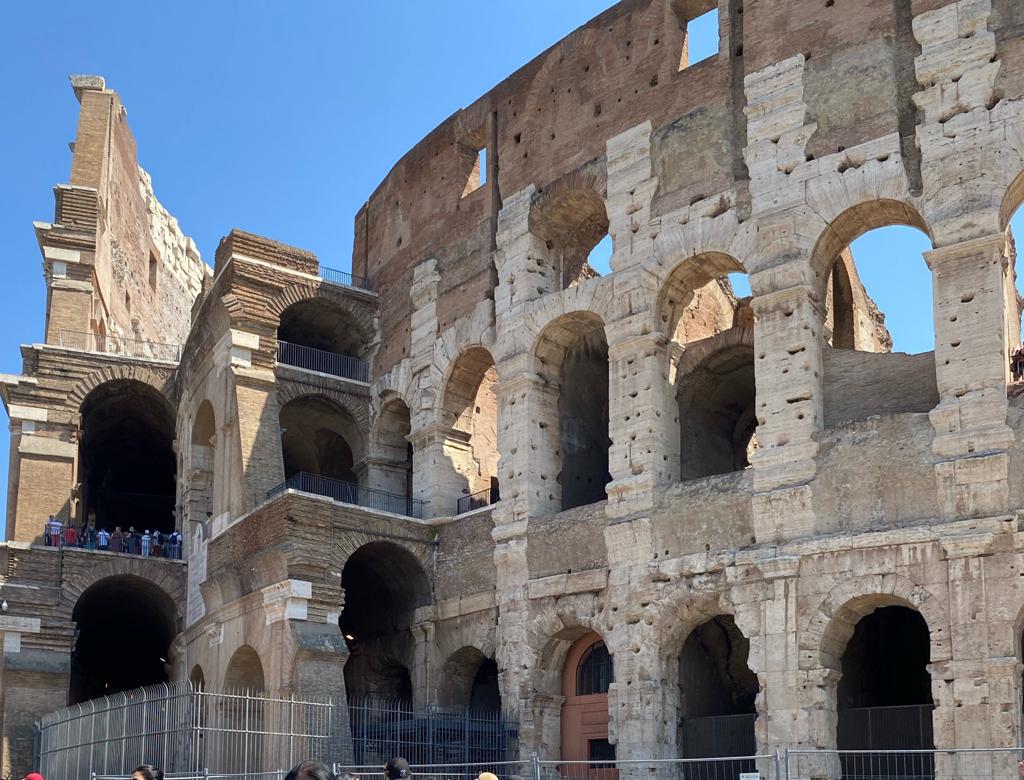
COLOSSEUM, ROME
We were heading to Rome from Aritzo. It was the second last day of our tour and the last night in Italy. All roads lead to Rome as they say. After reaching Rome we had a photo-stop at the Colosseum. The Colosseum is an elliptical Flavian amphitheatre in the centre of the city of Rome, just east of the Roman Forum. It is the largest ancient amphitheatre ever built in the world, despite its age. The construction of this amphitheatre was completed in 80 AD. It was constructed 2000 years ago and has a seating capacity of 50,000 to 80,000 spectators. Romans were considered cruel. They enjoyed bloodshed where male gladiators were made to fight animals, and slaves were made to fight Gladiators and in the end, whoever lost was subject to the spectator’s decision of being let off or being killed based on their thumbs up or a thumbs down. In case of thumbs down the loser used to be killed. After seeing the Colosseum we went for lunch at the Annapurna Restaurant. The good thing about Europe is that in every city you’ll find an Indian Restaurant.
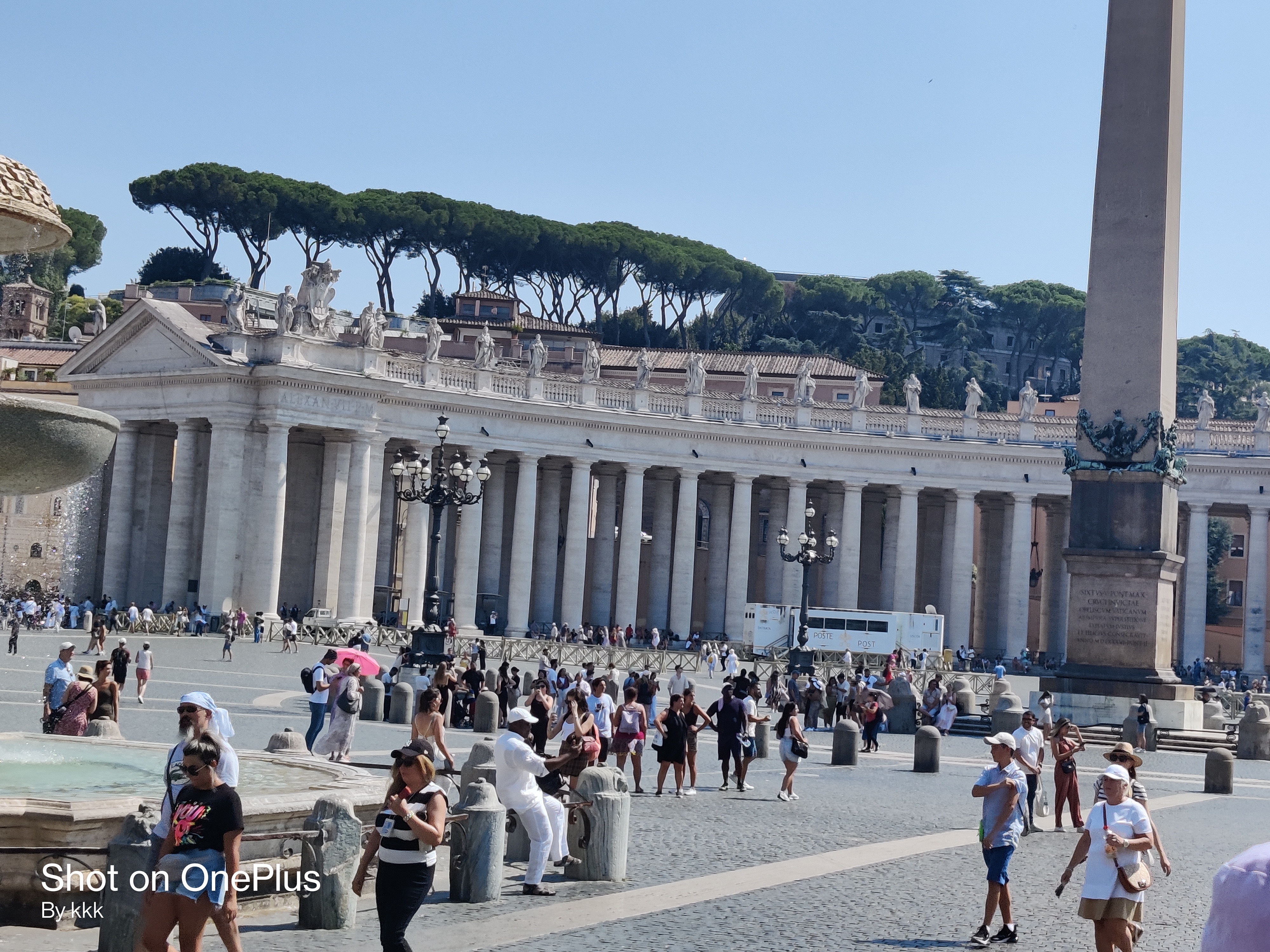
St Peter’s Square, Vatican.
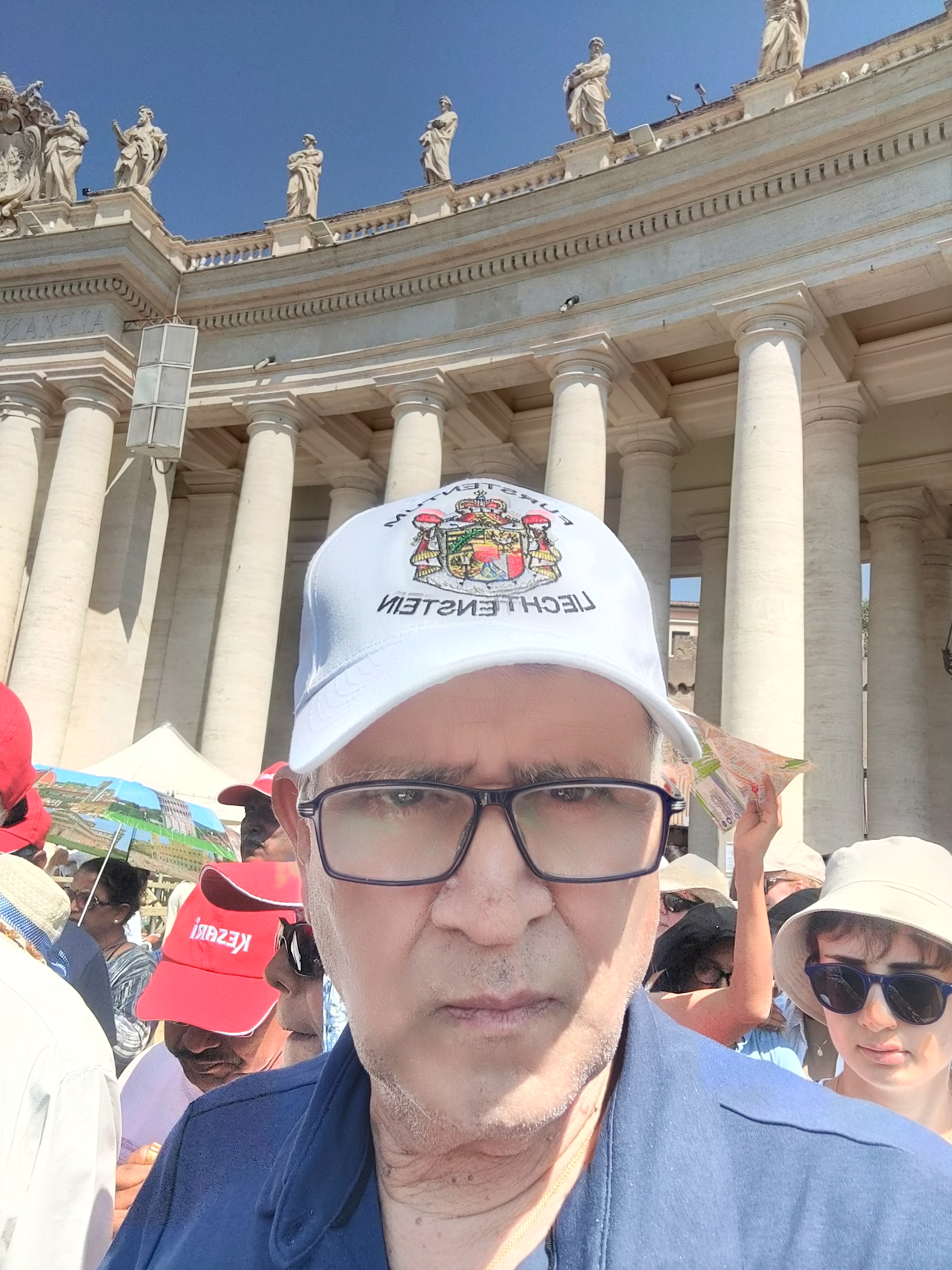
After lunch, we went on a guided tour to St Peter’s Basilica in the Vatican City. We were given earphones so that we could listen to our tour guide properly. We saw The Madonna della Pieta, informally known as La Pieta (Jesus in the lap of Mother Mary) a marble sculpture of Jesus and Mary at Mount Golgotha representing the “Sixth Sorrow” of the Blessed Virgin Mary by Michelangelo Buonarroti, now in Saint Peter’s Basilica, Vatican City. It is a key work of the Italian Renaissance sculpture and is often taken as the start of the High Renaissance. Down the line, we also got to see the Papal Tombs of the Popes who were buried there. Then there was the statue of the first Pope St. Peters. There was the bronze and gilded baldachin, the first work of Bernini (Bernini columns) to combine sculpture and architecture. We went past Michelangelo’s dome, columns, the Holy Water and the doors where you can wash your sins which open once in 25 years. Thereafter we had a photo session in St Peter Square and saw the two fountains created by Carlo Maderno and Gian Lorenzo Bernini. What was to follow was the residence of the earlier Pope and the gallery from where the current Pope Francis, addresses the public. After that, we left for our hotel Mercure Roma West.
AUTHOR KAMLESH TRIPATHI IN THE VATICAN
24.8.23
On the final day, we left our hotel at 11.15 AM. Lunch was in the Rome City Centre at noon. At 1.00 PM, we left for Trevi Fountain. It was a long walk to the monument as vehicles were not allowed there. We had a photo-op followed by last-minute shopping and a walking tour at 3 PM., of Rome Piazza Venezia (the square of Venice) a white-coloured monument building called the Typewriter Building or Wedding Cake Building, Mussolini’s Office, Town Hall and the Roman Forum Museum. At around 4.30 PM, we departed for Rome airport and reached there at 6 PM. We were to fly to Qatar by flight number QR 114 of Qatar Airways in the night. And from there to Mumbai on an Indigo international flight, and that was the end of this very exciting tour.
In a matter of 12 days, we drove through 10 countries and over 3000 km. This was possible only because of Kesari Tours, excellent roads, disciplined lane driving and the seamless borders of Europe.
Shravan Charity Mission is an NGO that works for poor children suffering from life-threatening diseases, especially cancer. Our posts are meant for our readers, including children and adults, and have a huge variety in content. We also accept donations for our mission. Should you wish to donate to the cause? The bank details are given below:
NAME OF ACCOUNT: SHRAVAN CHARITY MISSION
Account no: 680510110004635 (BANK OF INDIA)
IFSC code: BKID0006805
*
Kamlesh Tripathi’s Publications
GLOOM BEHIND THE SMILE
(The book is about a young cancer patient. Now archived in 8 prestigious libraries of the US which include Harvard College Library; Harvard University Library; Library of Congress; University of Washington, Seattle; University of Minnesota, Minneapolis; Yale University, New Haven; University of Chicago; University of North Carolina, at Chapel Hill University Libraries. It can also be accessed at MIT through Worldcat.org. Besides, it is also available for reading in libraries and archives of Canada; Cancer Aid and Research Foundation Mumbai; Jaipuria Institute of Management, Noida, India; Shoolini University, Yogananda Knowledge Center, Himachal Pradesh and Azim Premzi University, Bangalore).
ONE TO TANGO … RIA’S ODYSSEY
(Is a book on ‘singlehood’ about a Delhi girl now archived in Connemara Library, Chennai and Delhi Public Library, GOI, Ministry of Culture, Delhi; It is also available for reading in the Indian National Bibliography, March 2016, in the literature section, in Central Reference Library, Ministry of Culture, India, Belvedere, Kolkata-700022)
AADAB LUCKNOW … FOND MEMORIES
(Is a fiction written around the great city of Nawabs—Lucknow. It describes Lucknow in great detail and also talks about its Hindu-Muslim amity, which is the undying characteristic of Lucknow. The book was launched at the Lucknow International Literary Festival in 2014. It is included for reading in Askews and Holts Library Services, Lancashire, U.K; Herrick District Library, Holland and Charlotte-Mecklenburg Library, Mecklenburg County in North Carolina, USA; Black Gold Cooperative Library Administration, Arroyo Grande, California; Berkeley Library, University of California).
REFRACTIONS … FROM THE PRISM OF GOD
(Co-published by Cankids–Kidscan, a pan India NGO and Shravan Charity Mission, that works for child cancer in India. The book is endorsed by Ms Preetha Reddy, MD Apollo Hospitals Group. It was launched at the Lucknow International Literary Festival in 2016).
TYPICAL TALE OF AN INDIAN SALESMAN
(Is a story of an Indian salesman who is, humbly qualified. Yet he fights his way through unceasing uncertainties to reach the top. A good read not only for salesmen. The book was launched on 10th February 2018 at Gorakhpur Lit-Fest. Now available on Amazon, Flipkart and Onlinegatha)
RHYTHM … in poems
(Published in January 2019. The book contains 50 poems. The poems describe our day-to-day life. A few poems from the book have been published in Shillong Times, Bandra Times and Bhavan’s Journal. The book is available on Amazon, Flipkart and Onlinegatha)
MIRAGE
(Published in February 2020. The book is a collection of eight short stories available on Amazon, Flipkart and Notion Press)
AWADH ASSAM AND DALAI LAMA … The Kalachakra
(The story of the man who received His Holiness The Dalai Lama and his retinue in 1959 as a GOI representative when he fled Tibet in 1959. The book was launched on 21st November 2022 by His Holiness The Dalai Lama at Dharmshala. The title is archived in the library of the Department of Information and International Relations (DIIR) Government of Tibet, Tibet Policy Institute (TPI) and the personal library of His Holiness The Dalai Lama. The title is also archived in The Ohio Digital Library, USA. It was recently included in the digital library of the world-renowned company APPLE).
BHAVANS JOURNAL
Short stories, Book reviews and Articles published in Bhavan’s Journal: 1. Reality and Perception, 15.10.19; 2. Sending the Wrong Message, 31.5.20; 3.Eagle versus Scholars June, 15 & 20, 2020; 4.Indica, 15.8.20; 5.The Story of King Chitraketu, August 31 2020; 6.Breaking Through the Chakravyuh, September 30 2020. 7. The Questioning Spouse, October 31, 2020; 8. Happy Days, November 15, 2020; 9.The Karma Cycle of Paddy and Wheat, December 15, 2020; 10.Power Vs Influence, January 31, 2021; 11.Three Refugees, March 15, 2021; 12.Rise and Fall of Ajatashatru, March 31, 2021; 13.Reformed Ruler, May 15, 2021; 14.A Lasting Name, May 31, 2021; 15.Are Animals Better Teachers? June 16, 2021; 16.Book Review: The Gram Swaraj, 1.7.21; 17.Right Age for Achievements, 15.7.21; 18.Big Things Have Small Beginnings, 15.8.21; 19.Where is Gangaridai?, 15.9.21; 20.Confront the Donkey Within You 30.9.21; 21. Know Your Strengths 15.10.21; 22. Poverty 15.11.21; 23. Top View 30.11.21; 24. The Bansuriwala 15.1.22; 25.Sale of Alaska 15.2.22; 26.The Dimasa Kingdom 28.2.22; 27. Buried Treasure 15.4.22; 28. The Kingdom of Pragjyotisha 30.4.22; 29.Who is more useful? 15.5.22; 30. The White Swan from Lake Mansarovar 30.6.22; 31. Bhool Bhulayya 15.9.22; 32. Good Karma 30.9.22; 33. Good Name vs Bad Name 15.10.22; 34.Uttarapath—The Grand Trunk Road 1.12.22; 35.When Gods Get Angry 1.1.23; 36. Holinshed’s Chronicles 15.1.23; 37. Theogony 15.2.23; 38. Poem: Mother 14.5.23; 39. THE NAG MANDIR 30.6.23; 40. The Story of Garuda 30.7.23; 41. Janmabhoomi vs Karmabhoomi 31.8.23; 42. The Ghost Town of Kuldhara 15.9.23; 43. The Tale of Genji 15.10.23; 44. The Soul Connection 1.12.23;
SHILLONG TIMES—SUNDAY EDITION
ARTICLES & POEMS: 1. POEM: HAPPY NEW YEAR 8.1.23; 2. POEM: SPRING 12.3.23; 3. POEM: RIGHT AND WRONG 20.3.23; 4. THE GUSH OF EMOTION—WRITING, 26.3.23; 5. THE NAG MANDIR, 7.5.23; 6. POEM:MOTHER 7.5.23; 7. POEM: RAIN RAIN 9.7.23; 8. POEM:YOU COME ALONE YOUGO ALONE 6.8.23; 9. RAIN RAIN (SECOND TIME) 10.8.23; 10. POEM: GURU TEACHER 10.8.23; 11. POEM: AUTUMN … THE INTERIM HEAVEN 15.10.23; 12. POEM: HAPPY DIWALI 12.11.23; 13. OVERCOMING BLINDNESS: LEARN IT THE JOHN MILTON WAY 10.12.23; 14. THE HAPPY PRINCE AND THE HAPPY MAN’S SHIRT 31.12.23; 15. ANNUS MIRABILIS 2024 7.1.24; 16. GANDHI TO MAHATMA GANDHI- Incidents that Shaped Gandhi in South Africa 28.1.24;
THE ASSAM TRIBUNE
ARTICLE: 1. THE MAGIC OF READING 11.12.23; 2. GANDHI TO MAHATMA 29.1.24
29.12.2020: INDICA BY MEGASTHENES; 14.3.22: ABOUT THE DIMASA KINGDOM ASSAM; 10.12.22: GRAND TRUNK ROAD-UTTARAPATH; 5.10.23: THE GHOST TOWN OF KULDHARA NEAR JAISALMER;
(ALL THE ABOVE BOOK TITLES ARE AVAILABLE FOR SALE ON AMAZON, FLIPKART AND OTHER ONLINE STORES OR YOU COULD EVEN WRITE TO US FOR A COPY)
The Tragedy of Julius Caesaris a historic tragic play by William Shakespeare first performed in 1599. It is one of several plays written by Shakespeare based on true events from the Roman history.
Julius Caesar, was a Roman general and statesman who played a critical role in the events that led to the demise of the Roman Republic and the rise of the Roman Empire.
Set in Rome in 44 BC, the play depicts the moral dilemma of Brutus as he joins the conspiracy led by Cassius to murder Julius Caesar to prevent him from becoming the dictator of Rome. Following Caesar’s death, Rome is thrust into a period of civil war, and the republic, which the conspirators sought to preserve is lost forever.
Let me first describe the main characters of the play to you:
Gaius Julius Caesar: Known simply as Julius Caesar, was a Roman general and statesman who played a critical role in the events that led to the demise of the Roman Republic and the rise of the Roman Empire. He was also a historian and author of Latin prose.
Marcus Junius Brutus: Often referred to as Brutus, was a Roman senator and the most famous of the assassins of Julius Caesar. After being adopted by an uncle of his, he used the name Quintus Servilius Caepio Brutus, but subsequently returned to his birth name. Brutus was close to General Julius Caesar, the leader of the Populares faction, a political group.
Gaius Cassius Longinus: Often referred to as Cassius, was a Roman senator and a general best known as a leading instigator of the plot to assassinate Julius Caesar. He was the brother-in-law of Brutus, another leader of the conspiracy. He commanded troops with Brutus during the Battle of Philippi against the combined forces of Mark Antony and Octavian, all Caesar’s former supporters, and committed suicide after being defeated by Mark Antony.
Marcus Antonius: Commonly known in English as Mark Antony or Anthony, was a Roman politician and general who played a critical role in the transformation of the Roman Republic from an oligarchy a power structure in which the power rests in a small set of people into the autocratic Roman Empire. Antony was a supporter of Julius Caesar, and served as one of his generals during the conquest of Gaul (war against Gallic tribes) and the Civil War. Antony was appointed administrator of Italy while Caesar eliminated political opponents in Greece, North Africa, and Spain.
Calpurnia: Either the third or the fourth wife of Julius Caesar, and the one to whom he was married at the time of his assassination.
Octavian: Caesar’s great-nephew and adopted son.
Pompey: A leading general.
Metellus Cimber: A Roman senator and also an assassin of Julius Caesar.
Lepidus: A Roman general.
Titinius: A noble man of Rome.
Casca: A public figure and an assassin of Julius Caesar.
The play opens with two tribunes (title of various elected officials in Rome) discovering the commoners of Rome celebrating Julius Caesar’s triumphant return from defeating the sons of his military rival, Pompey (a leading general). These tribunes, then insult the crowd for their change in loyalty from Pompey to Caesar. The officials then attempt to end the celebrations and break up with the commoners, who also return the insults. Later during the feast of Lupercal, (a pre-Roman pastoral annual festival) Caesar holds a victory parade when a soothsayer warns him to “Beware of the ides of March”, (the 74th day in the Roman calendar that corresponds to 15 March which means be careful as your life is in danger around that time) which Caesar ignores. Meanwhile, Cassius attempts to convince Brutus to join his conspiracy to kill Caesar. Brutus is friendly with Caesar, therefore hesitant to kill him. But he agrees that Caesar might be abusing his power so he needs to be killed. They then hear from Cacsa that Mark Antony has offered Caesar the crown of Rome three times and that each time Caesar refused it with increasing reluctance, in a hope that the crowd watching would beg him to accept the crown, yet the crowd applauded Caesar for denying the crown, upsetting Caesar, who actually wanted to accept the crown. On the eve of the ides of March, the conspirators meet and reveal that they have forged letters of support from the Roman people to tempt Brutus into joining. Brutus reads the letters and, after a lot of moral debate, decides to join the conspiracy, thinking that Caesar should be killed to prevent him from doing anything against the people of Rome if he were, ever to be crowned.
Caesar ignores the soothsayer, as well as his wife Calpurnia’s own premonitions. Calpurnia was either the third or the fourth wife of Julius Caesar, and the one to whom he was married at the time of his assassination. According to contemporary sources, she was a good and faithful wife, in spite of her husband’s infidelity. She had forewarned Caesar of the attempt on his life, but her endeavour remained in vain and did not prevent his murder.
Caesar goes to the Senate. The conspirators approach him with a fake petition pleading on behalf of Metellus Cimber’s banished brother. (Metellus Cimber is a Roman senator and also an assassin of Julius Caesar). As Caesar predictably rejects the petition, Casca and the others suddenly stab him. Brutus is last to do so. At this point, Caesar utters the famous line, “Et tu, Brute?” (“And you, Brutus?” … “You too, Brutus?”). The scene concludes with the quote, “Then fall, Caesar!” which means that Caesar will fall both as a man and also as the ruler of Rome.
The conspirators make it clear, that they committed the murder for the good of Rome, not for their own purposes, and do not attempt to flee the scene. Brutus delivers an oration defending his own actions, and for that moment, the crowd is on his side. However, Mark Antony makes a subtle and eloquent speech over Caesar’s corpse, beginning with the much-quoted, “Friends, Romans, countrymen, lend me your ears!” With this, he deftly turns the public opinion against the assassins by manipulating the emotions of the common people, in contrast to the rational tone of Brutus’ speech. He reminds them of the good that Caesar had done for Rome, his sympathy for the poor, and his refusal of the crown at the Lupercal festival, thus questioning Brutus’ claim of Caesar’s ambition. He shows Caesar’s bloodied, lifeless body to the crowd to have them shed tears and thus gain sympathy for their fallen hero. He reads Caesar’s will, in which every Roman citizen would receive 75 drachmas (the Greek currency). Antony, finally manages to rouse the mob to drive the conspirators away from Rome.
Brutus next … attacks Cassius for supposedly soiling the noble act of regicide (the deliberate killing of a monarch) by having accepted bribes. The two later reconcile, especially, after Brutus reveals that his beloved wife has committed suicide under the stress of his absence from Rome. They prepare for a civil war against Mark Antony and Caesar’s adopted son Octavius, who have formed a triumvirate (a group) in Rome with Lepidus a Roman general. That night, Caesar’s ghost appears in front of Brutus with a warning of defeat. (He informs Brutus, “Thou shalt see me at Philippi.” a Greek city).
At the battle of Philippi, Cassius and Brutus, knowing well, that they will probably, both die, smile their last smiles, at each other and hold hands. During the battle, Cassius has his servant, kill him, after hearing of, the capture of his best friend, Titinius—a noble man of Rome, and a friend of Cassius and a conspirator in Caesar’s death. After Titinius, who was not really captured, sees Cassius’ corpse, he commits suicide. However, Brutus wins, that stage of the battle, but his victory is not conclusive. With a heavy heart, Brutus battles again the next day. He loses and commits suicide by running on his own sword, held for him by a loyal soldier.
The play ends with a tribute to Brutus by Antony, who proclaims that Brutus has remained “the noblest Roman of them all” because he was the only conspirator who acted, in his mind, for the good of Rome and was never jealous of Caesar
Though Brutus acted in the interest of Rome as per Antony, but in the process, he did kill his friend Caesar, after which his name Brutus became the best metaphor for stabbing at the back.
Shravan Charity Mission is an NGO that works for poor children suffering from life threatening diseases especially cancer. Our posts are meant for our readers that includes both children and adults and it has a huge variety in terms of content. We also accept donations for our mission. Should you wish to donate for the cause. The bank details are given below:
NAME OF ACCOUNT: SHRAVAN CHARITY MISSION
Account no: 680510110004635 (BANK OF INDIA)
IFSC code: BKID0006805
*
Our publications
GLOOM BEHIND THE SMILE
(The book is about a young cancer patient. Now archived in 7 prestigious libraries of the US, including, Harvard University and Library of Congress. It can also be accessed in MIT through Worldcat.org. Besides, it is also available for reading in Libraries and archives of Canada and Cancer Aid and Research Foundation Mumbai)
ONE TO TANGO … RIA’S ODYSSEY
(Is a book on ‘singlehood’ about a Delhi girl now archived in Connemara Library, Chennai and Delhi Public Library, GOI, Ministry of Culture, Delhi)
AADAB LUCKNOW … FOND MEMORIES
(Is a fiction written around the great city of Nawabs—Lucknow. It describes Lucknow in great detail and also talks about its Hindu-Muslim amity. That happens to be its undying characteristic. The book was launched in Lucknow International Literary Festival of 2014)
REFRACTIONS … FROM THE PRISM OF GOD
(Co-published by Cankids–Kidscan, a pan India NGO and Shravan Charity Mission, that works for Child cancer in India. The book is endorsed by Ms Preetha Reddy, MD Apollo Hospitals Group. It was launched in Lucknow International Literary Festival 2016)
TYPICAL TALE OF AN INDIAN SALESMAN
(Is a story of an Indian salesman who is, humbly qualified. Yet he fights his ways through unceasing uncertainties to reach the top. A good read not only for salesmen. The book was launched on 10th February, 2018 in Gorakhpur Lit-Fest. Now available in Amazon, Flipkart and Onlinegatha)
RHYTHM … in poems
(Published in January 2019. The book contains 50 poems. The poems describe our day to day life. The book is available in Amazon, Flipkart and Onlinegatha)
MIRAGE
(Published in February 2020. The book is a collection of eight short stories. It is available in Amazon, Flipkart and Notion Press)
(ALL THE ABOVE TITLES ARE AVAILABLE FOR SALE IN AMAZON, FLIPKART AND OTHER ONLINE STORES OR YOU COULD EVEN WRITE TO US FOR A COPY)
The Nuremberg trials were a series of military tribunals held after World War II by the Allied Forces (The Allies or the Allied Forces of World War II, were called so, by the United Nations, in their January 1 1942 declaration.) They were the countries that together opposed the Rome-Berlin-Tokyo Axis powers during the Second World War (1939-1945). The Allies promoted the alliance as a means to control German, Japanese and the Italian aggression under international law and the laws of the war. The trials were most notable for the prosecution of prominent members of the political, military, judicial, and economic leadership of Nazi Germany. Nazi Germany was the common English name for Germany between 1933 and 1945, when Adolf Hitler and his Nazi Party (NSDAP) ruled the country through dictatorship.
Under Hitler’s rule, Germany became a totalitarian state when nearly all aspects of life were controlled by the government who planned, supervised, and horrendously carried out the holocaust. The holocaust, also known as the Shoah, was World War II’s genocide of the European Jews, between 1941 and 1945 across German-occupied Europe when, Nazi Germany and its collaborators systematically murdered some six million Jews, around two-thirds of Europe’s Jewish population and committed other war crimes.
War Crime is an act that constitutes a serious violation of the laws of war that gives rise to individual criminal responsibility. Examples of war crimes include intentionally killing civilians or prisoners, torturing, destroying civilian property, taking hostages, performing perfidy, raping, using child soldiers and pillaging. The trials were held in Nuremberg. Nuremberg is the second-largest city of the German federal state of Bavaria after its capital Munich. The trials marked a turning point between classical and contemporary international law.
The first and the best known trials was that of the major war criminals before the International Military Tribunal (IMT). It was described as “the greatest trial in history” by Sir Norman Birkett, a British barrister, judge, politician and preacher who served as the alternate British judge during the Nuremberg trials, and one of the British judges present throughout. The trial was held between 20 November 1945 and 1 October 1946.
The Tribunal was given the task of trying 24 of the most important political and military leaders of the Third Reich. Reich is a German word analogous to the English word meaning ‘realm of a king.’ Some important names that were put to trial were as follows:
Let me begin with Martin Bormann who had died in May 1945 but the fact was not known to the allies and he was tried in absentia. Martin Ludwig Bormann was a German Nazi Party official and head of the Nazi Party Chancellery. He gained immense power by using his position as Adolf Hitler’s private secretary to control the flow of information and access to Hitler. After Hitler’s suicide on 30 April 1945, another defendant, Robert Ley, committed suicide within a week of his trial’s commencement.
Adolf Hitler killed himself by a gunshot on 30 April 1945 in his Fuhrerbunker in Berlin. Eva Braun, his wife too committed suicide along with him by taking cyanide. In accordance with Hitler’s prior written and verbal instructions that afternoon, their remains were carried up the stairs through the bunker’s emergency exit, doused in petrol, and set alight in the Reich Chancellery garden outside the bunker. Records in the Soviet archives show that their burned remains were recovered and interred in successive locations until 1946. They were exhumed again and cremated in 1970, and the ashes were scattered.
Hitler had retreated to his bunker on January 16, after deciding to remain in Berlin for the last great siege of the war. Fifty-five feet under the chancellery (Hitler’s headquarters as chancellor), the shelter contained 18 small rooms and was fully self-sufficient, with its own water and electricity supply. He went out very rarely (once to decorate a squadron of Hitler Youth) and spent most of his time micromanaging what was left of German defenses and entertaining guests such as Hermann Goering, Heinrich Himmler, and Joachim von Ribbentrop. At his side was Eva Braun, whom he married only two days before their double suicide, and his dog, an Alsatian named Blondi.
Warned by officers that the Russians were only a day or so away from overtaking the chancellery and urged him to escape to Berchtesgarden, a small town in the Bavarian Alps where Hitler owned a home, but the dictator instead chose suicide. It is believed that both he and his wife swallowed cyanide capsules which had been tested for its efficacy on his “beloved” dog and her pups. And for good measure, he even shot himself with his service pistol.
The bodies of Hitler and Eva were cremated in the chancellery garden by the bunker survivors as per Der Fuhrer’s orders, and reportedly later recovered in parts by Russian troops. A German court finally officially declared Hitler dead, but not until 1956.
Adolf Hitler and Joseph Goebbels a German Nazi politician and a Reich Minister for Propoganda of the Nazi Germany from 1933 to 1945, had both committed suicide in the spring of 1945 to avoid capture. Heinrich Himmler another leader of the Nazi Party, attempted to commit suicide, but was captured before he could succeed. He committed suicide one day after being arrested by British forces. On the other hand Heinrich Muller better known as Gestapo Muller the SS Gestapo chief of Hitler, who was central in planning the holocaust disappeared the day after Hitler’s suicide. He was the most senior figure of the Nazi regime whose fate remains unknown. He was neither captured nor confirmed to have died.
Further Reinhard Heydrich a high-ranking German SS and police official of the Nazi era and the main architect of the holocaust was assassinated by Czech partisans in 1942. Josef Terboven another Nazi leader killed himself with dynamite in Norway in 1945. Adolf Eichmann fled to Argentina to avoid capture but was apprehended by Israel’s intelligence service (Mossad) and hanged after a trial in Jerusalem in 1962. Hermann Goring was sentenced to death but he committed suicide by swallowing cyanide the night before his execution.
Primarily conducted in Nuremberg were the first initial trials, adjudicated by the International Military Tribunal. Further trials of lesser war criminals were conducted under Control Council Law No. 10 at the U.S. Nuremberg Military Tribunal (NMT), which included Doctors’ and Judges’ trial who too were part of war crimes.
The categorization of the crimes and the constitution of the court represented a juridical advance that was to be followed afterward by the United Nations for the development of an international jurisprudence in matters of war crimes, crimes against humanity, and wars of aggression, and led to the creation of the International Criminal Court. For the first time in international law, the Nuremberg indictments also mentioned genocide (count three, war crimes: “the extermination of racial and national groups, against the civilian populations of certain occupied territories in order to destroy particular races and classes of people and national, racial, or religious groups, particularly Jews, Poles, Gypsies and others”).
A precedent for trying those accused, of war crimes, had also been set up, at the end of World War I, in the Leipzig War Crimes Trials. The Leipzig War Crimes Trials were a series of trials held in 1921 to try alleged German war criminals of the First World War before the German Reichsgericht (the Supreme Court) in Leipzig, as part of the penalties imposed on the German government under the Treaty of Versailles. Only twelve individuals were brought to trial with mixed results, and the proceedings were widely regarded at the time as a failure. In the longer term, however, the trials were seen as a significant step towards the introduction of a comprehensive system for the prosecution of violations of international law.
Shravan Charity Mission is an NGO that works for poor children suffering from life threatening diseases especially cancer. Our posts are meant for our readers that includes both children and adults and it has a huge variety in terms of content. We also accept donations for our mission. Should you wish to donate for the cause. The bank details are given below:
NAME OF ACCOUNT: SHRAVAN CHARITY MISSION
Account no: 680510110004635 (BANK OF INDIA)
IFSC code: BKID0006805
*
Our publications
GLOOM BEHIND THE SMILE
(The book is about a young cancer patient. Now archived in 7 prestigious libraries of the US, including, Harvard University and Library of Congress. It can also be accessed in MIT through Worldcat.org. Besides, it is also available for reading in Libraries and archives of Canada and Cancer Aid and Research Foundation Mumbai)
ONE TO TANGO … RIA’S ODYSSEY
(Is a book on ‘singlehood’ about a Delhi girl now archived in Connemara Library, Chennai and Delhi Public Library, GOI, Ministry of Culture, Delhi)
AADAB LUCKNOW … FOND MEMORIES
(Is a fiction written around the great city of Nawabs—Lucknow. It describes Lucknow in great detail and also talks about its Hindu-Muslim amity. That happens to be its undying characteristic. The book was launched in Lucknow International Literary Festival of 2014)
REFRACTIONS … FROM THE PRISM OF GOD
(Co-published by Cankids–Kidscan, a pan India NGO and Shravan Charity Mission, that works for Child cancer in India. The book is endorsed by Ms Preetha Reddy, MD Apollo Hospitals Group. It was launched in Lucknow International Literary Festival 2016)
TYPICAL TALE OF AN INDIAN SALESMAN
(Is a story of an Indian salesman who is, humbly qualified. Yet he fights his ways through unceasing uncertainties to reach the top. A good read not only for salesmen. The book was launched on 10th February, 2018 in Gorakhpur Lit-Fest. Now available in Amazon, Flipkart and Onlinegatha)
RHYTHM … in poems
(Published in January 2019. The book contains 50 poems. The poems describe our day to day life. The book is available in Amazon, Flipkart and Onlinegatha)
MIRAGE
(Published in February 2020. The book is a collection of eight short stories. It is available in Amazon, Flipkart and Notion Press)
(ALL THE ABOVE TITLES ARE AVAILABLE FOR SALE IN AMAZON, FLIPKART AND OTHER ONLINE STORES OR YOU COULD EVEN WRITE TO US FOR A COPY)
This is only an attempt to create interest in reading. We may not get the time to read all the books in our lifetime. But such reviews, talk and synopsis will at least convey what the book is all about.
James Joyce is a 20th-century writer. His full name was James Augustine Aloysius Joyce (life span: 2 February 1882 – 13 January 1941) was an Irish novelist, short story writer, poet, teacher, and a literary critic. He contributed to the modernist avant-garde, and is regarded as one of the most influential and important authors of the 20th century. Joyce is best known for Ulysses (written in 1922), a landmark work in which the episodes of Homer’s Odyssey are paralleled in a variety of literary styles, most famously stream of consciousness (a narrative mode). In literature Ulysses was also the hero of Homer’s Odyssey.
Other well-known works of James Joyce are the short-story collection ‘Dubliners’ (1914), and the novels, ‘A Portrait of the Artist as a Young Man’ (1916) and ‘Finnegans Wake’ (1939). His other writings include three books of poetry, a play, his published letters and occasional journalism. Apart from writing he also had an accomplished tenor and therefore could sing well.
EARLY LIFE
He was born on 2 February 1882, in Dublin, Ireland. Joyce’s father was John Stanislaus Joyce and his mother was Mary Jane “May” Murray. He was the eldest of ten surviving siblings; two died of typhoid. James was baptised according to the rites of the Catholic Church.
In 1887, his father was appointed rate collector by Dublin Corporation. The family subsequently moved to the fashionable adjacent small town of Bray, 12 miles from Dublin. Around this time Joyce was attacked by a dog, leading to his lifelong cynophobia (fear of dogs). He also suffered from astraphobia (fear of thunder and lightning).
EDUCATION
Joyce had begun his education at Clongowes Wood College, a Jesuit boarding school near Clane, County Kildare, Ireland, in 1888, but had to leave it, in 1892, when his father could no longer pay the fee. Joyce then studied at home and briefly at the Christian Brothers O’Çonnel School, on North Richmond Street, in Dublin, before he was offered a place in the Jesuits’ Dublin school, Belvedere College, in 1893.
Joyce later enrolled at the established University College Dublin (UCD) in 1898, studying English, French and Italian. He became active in theatrical and literary circles in the city. Joyce wrote a number of articles and at least two plays (since lost) during this period. Many of the friends he made at University College Dublin appeared as characters in Joyce’s works. Joyce was first introduced to the Irish public by Arthur Griffith in his newspaper, United Irishman, in November 1901. Joyce had written an article on the Irish Literary Theatre and his college magazine refused to print it. Joyce had it printed himself and distributed it locally. In 1901, the National Census of Ireland listed James Joyce (19) as an English- and Irish-speaking scholar living with his mother and father, six sisters and three brothers at Royal Terrace (now Inverness Road), Clontarf, Dublin.
PERSONAL HABITS: A lot has been spoken about his drinking habit. His father John Joyce too, was into, heavy drinking and even lost his job because of that and the habit was imbibed by his son James Joyce. James occasionally even got into brawls because of his drinking habit. He also had a very restless life.
HIS RESTLESS EARLY LIFE
After graduating from University College Dublin in 1902, Joyce left for Paris to study medicine, but he soon abandoned it. This may have been because he found the technical lectures in French too difficult. Joyce had earlier failed to pass chemistry in his own English language in Dublin. But Joyce claimed ill health as the problem and wrote home that he was unwell and complained about the cold weather. He stayed on for a few months, appealing for finance which his family could ill-afford. His mother was diagnosed of cancer, when his father sent him a telegram that read, “NOTHER DYING COME HOME FATHER”. (Nother—a non-standard spelling for another) Joyce returned to Ireland. Fearing for her son’s impiety, his mother tried unsuccessfully to get Joyce to make his confession and to take communion. She finally passed into a coma and died. James and his brother Stanislaus refused to kneel with other members of the family praying by her bedside. After her death he continued to drink heavily, as a consequence conditions at home grew quite appalling. He scraped together a living by reviewing books, teaching, and singing.
ABOUT HIS WRITING
In 1904, while in his early twenties, Joyce emigrated to continental Europe with his partner (and later wife) Nora Barnacle. They lived in Trieste—Italy, Paris, and Zurich. Although most of his adult life was spent abroad, Joyce’s fictional universe centres on Dublin and is populated largely by characters who closely resemble family members, enemies and friends from his time there. Ulysses in particular is set with precision in the streets and alleyways of the city.
In 1891 Joyce wrote a poem on the death of Charles Stewart Parnell. His father was angry at the treatment of Parnell by the Catholic Church. The elder Joyce had the poem printed and even sent a part to the Vatican Library.
On 7 January 1904, Joyce attempted to publish ‘A Portrait of the Artist’ an essay-story dealing with aesthetics, only to have it rejected by the free-thinking magazine Dana. He decided, on his twenty-second birthday, to revise the story into a novel he called Stephen Hero. It was a fictional rendering of Joyce’s youth, but he eventually grew frustrated with its direction and abandoned this work. It was never published in this form, but years later, in Trieste, Joyce completely rewrote it, as ‘A Portrait of the Artist as a Young Man.’ The unfinished Stephen Hero was published after his death.
In 1904, he met Nora Barnacle, a young woman from Galway city, Ireland, who was working as a chambermaid. On 16 June 1904 they had their first outing together, they walked to the Dublin suburb of Ringsend, where Nora masturbated him sexually. This event was commemorated by providing the date for the action of Ulysses (as “Bloomsday”).
Joyce and Nora went into self-imposed exile, moving first to Zürich in Switzerland, where he ostensibly taught English at the Berlitz Language School. Later he was sent to Trieste, which was then part of Austria-Hungary (until the First World War), and is today part of Italy. He later taught in Pola, part of Croatia today. He stayed there, teaching English mainly to Austro-Hungarian naval officers stationed at the Pola base, from October 1904 until March 1905. Later he moved back to Trieste and began teaching English there. He remained in Trieste for the next ten years.
Later that year Nora gave birth to their first child, George (known as Giorgio). Joyce persuaded his brother, Stanislaus, to join him in Trieste, and secured a teaching position for him at the school. Joyce sought to augment his family’s meagre income with his brother’s earnings. Stanislaus and Joyce had strained relations while they lived together in Trieste, arguing about Joyce’s drinking habits and frivolity with money.
Joyce became frustrated with life in Trieste and moved to Rome in late 1906, taking employment as a clerk in a bank. But he disliked Rome and returned to Trieste in early 1907. So it was either Trieste or Dublin for him. His daughter Lucia was born later that year.
Joyce returned to Dublin in mid-1909 with George his son, to visit his father and work on getting Dubliners published. While preparing to return to Trieste he decided to take one of his sisters, Eva, back with him to help Nora run the home. He spent a month in Trieste before returning to Dublin, this time as a representative of some cinema owners and businessmen from Trieste. With their backing he launched Ireland’s first cinema, the Volta Cinematography, which was well-received, but fell apart after Joyce left. He returned to Trieste in January 1910 with another sister, Eileen, in tow. For Eva had become homesick for Dublin and returned a few years later, but Eileen spent the rest of her life on the continent.
Joyce returned to Dublin again briefly in mid-1912 for publishing his book ‘Dubliners’ but landed into a disagreement with his Dublin publisher. His trip was fruitless and upon his return he wrote a poem “Gas from a Burner’ as an invective, against publisher Roberts. After this trip, he never again came closer to Dublin than London, despite many pleas from his father and invitations from his fellow Irish writer, William Butler Yeats.
One of his students in Trieste, Ettore Smith Ettore Schmitz, better known by the pseudonym Italo Svevo. They met in 1907 and became lasting friends and mutual critics. Schmitz was a Catholic of Jewish origin and became a primary model for Leopold Bloom; (the fictional protagonist and hero of James Joyce’s Ulysses) most of the details about the Jewish faith in Ulysses came from Schmitz’s responses to queries from Joyce. While living in Trieste, Joyce was first beset with eye problems that ultimately required over a dozen surgical operations.
Joyce concocted a number of money-making schemes during this period, including an attempt to become a cinema magnate in Dublin. In 1915, after most of his students in Trieste were con-scripted to fight in the First World War, Joyce moved to Zürich. Joyce set himself to finishing Ulysses in Paris, delighted to find that he was gradually gaining fame as an avant-garde writer. A further grant from a well-wisher meant he could devote himself full-time into writing again, as well as consort with other literary figures in the city. During this time, Joyce’s eyes began to give him more and more problems and he often wore an eye-patch. He was treated in Paris, undergoing nine operations before his surgeon’s death in 1929. Throughout the 1930s he travelled frequently to Switzerland for eye surgeries and for treatments for his daughter Lucia, who, according to the Joyces, suffered from schizophrenia. Lucia was analysed by Carl Jung a Swiss Psychiatrist at the time, who after reading U-lysses, is said to have concluded that her father too had schizophrenia. Jung said that she and her father were two people heading to the bottom of a river, except that Joyce was diving and Lucia was sinking.
In Paris, two litterateurs or say activists nursed Joyce during his long years of writing ‘Finnegans Wake.’ Had it not been for their support this book probably would not have seen the light of the day.
JOYCE AND RELIGION
The issue of Joyce’s relationship with religion is somewhat controversial. Early in life, he gave up on Catholicism. He expressed—My mind rejects the whole present social order and Christianity. Six years ago I left the Catholic church, hating it most fervently. I found it impossible for me to remain in it on account of the impulses of my nature. I made secret war upon it when I was a student and declined to accept the positions it offered me. By doing this I made myself a beggar but I retained my pride. Now I make open war upon it by what I write and say and do.
When the arrangements for Joyce’s burial were being made, a Catholic priest offered a religious service, which Joyce’s wife, Nora, declined, saying, “I couldn’t do that to him.”
Some novelist and historians have argued that Joyce, later in life, reconciled with the faith he rejected earlier and that his parting with the faith was succeeded, by a not so obvious reunion, and that Ulysses and Finnegans Wake are essentially Catholic expressions. Likewise, Hugh Kenner and T.S. Eliot believed they saw between the lines of Joyce’s work the outlook of a serious Christian and that beneath the veneer of the work lies a remnant of a Catholic belief and attitude. Kevin Sullivan maintains that, rather than reconciling with the faith, Joyce never left it.
DEATH
On 11 January 1941, Joyce underwent a surgery in Zürich for a perforated duodenal ulcer. He fell into a coma the following day. He awoke at 2 a.m. on 13 January 1941, and asked a nurse to call his wife and son, before losing consciousness again. They were en route when he died 15 minutes later. Joyce was less than a month short of his 59th birthday. His body was buried in the Fluntern Cemetery, Zürich. Although two senior Irish diplomats were in Switzerland at the time of his death, neither attended Joyce’s funeral, and the Irish government later declined Nora’s offer to permit the repatriation of Joyce’s remains.
When Joseph Walshe secretary at the Department of External Affairs in Dublin was informed of Joyce’s death he remarked—‘If possible find out did he die a Catholic? Express sympathy with Mrs Joyce and explain inability to attend funeral.’ Buried originally in an ordinary grave, Joyce was moved in 1966 to a more prominent “honour grave,” with a seated portrait statue by American artist Milton Hebald nearby. Nora, whom he had married in 1931, survived him by 10 years. She is buried by his side, as is, their son Giorgio, who died in 1976.
Shravan Charity Mission is an NGO that works for poor children suffering from life threatening diseases especially cancer. Our posts are meant for our readers that includes both children and adults and it has a huge variety in terms of content. We also accept donations for our mission. Should you wish to donate for the cause. The bank details are given below:
NAME OF ACCOUNT: SHRAVAN CHARITY MISSION
Account no: 680510110004635 (BANK OF INDIA)
IFSC code: BKID0006805
*
Our publications
GLOOM BEHIND THE SMILE
(The book is about a young cancer patient. Now archived in 7 prestigious libraries of the US, including, Harvard University and Library of Congress. It can also be accessed in MIT through Worldcat.org. Besides, it is also available for reading in Libraries and archives of Canada and Cancer Aid and Research Foundation Mumbai)
ONE TO TANGO … RIA’S ODYSSEY
(Is a book on ‘singlehood’ about a Delhi girl now archived in Connemara Library, Chennai and Delhi Public Library, GOI, Ministry of Culture, Delhi)
AADAB LUCKNOW … FOND MEMORIES
(Is a fiction written around the great city of Nawabs—Lucknow. It describes Lucknow in great detail and also talks about its Hindu-Muslim amity. That happens to be its undying characteristic. The book was launched in Lucknow International Literary Festival of 2014)
REFRACTIONS … FROM THE PRISM OF GOD
(Co-published by Cankids–Kidscan, a pan India NGO and Shravan Charity Mission, that works for Child cancer in India. The book is endorsed by Ms Preetha Reddy, MD Apollo Hospitals Group. It was launched in Lucknow International Literary Festival 2016)
TYPICAL TALE OF AN INDIAN SALESMAN
(Is a story of an Indian salesman who is, humbly qualified. Yet he fights his ways through unceasing uncertainties to reach the top. A good read not only for salesmen. The book was launched on 10th February, 2018 in Gorakhpur Lit-Fest. Now available in Amazon, Flipkart and Onlinegatha)
RHYTHM … in poems
(Published in January 2019. The book contains 50 poems. The poems describe our day to day life. The book is available in Amazon, Flipkart and Onlinegatha)
(ALL THE ABOVE TITLES ARE AVAILABLE FOR SALE IN AMAZON, FLIPKART AND OTHER ONLINE STORES OR YOU COULD EVEN WRITE TO US FOR A COPY)






 Shravan charity mission