Copyright@shravancharitymission
5/10/25 SPEAKING TREE
PEOPLE, ANIMALS & ENVIRONMENT
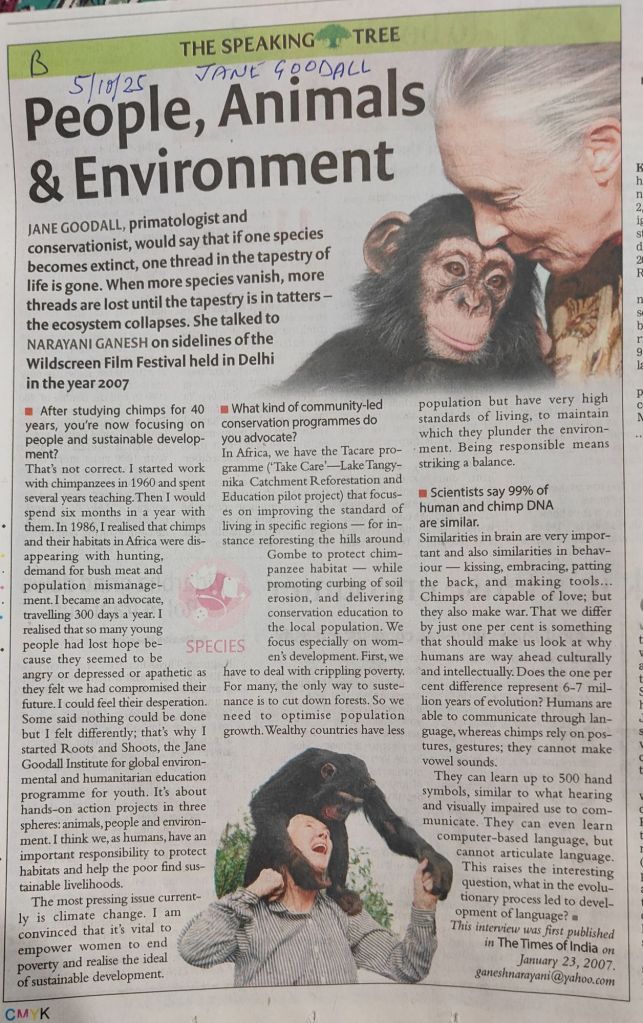
JANE GOODALL, primatologist and conservationist, would say that if one species becomes extinct, one thread in the tapestry of life is gone. When more species vanish, more threads are lost until the tapestry is in tatters– the ecosystem collapses. She spoke with NARAYANI GANESH on the sidelines of the Wildscreen Film Festival held in Delhi in 2007.
Q. After studying chimps for 40 years, you’re now focusing on people and sustainable development?
That’s not correct. I started work with chimpanzees in 1960 and spent several years teaching. Then I would spend six months of the year with them. In 1986, I realised that chimps and their habitats in Africa were disappearing with hunting, demand for bush meat and population mismanagement. I became an advocate, travelling 300 days a year. I realised that so many young people had lost hope because they seemed to be angry or depressed, or apathetic, as they felt we had compromised their future. I could feel their desperation. Some said nothing could be done, but I felt differently; that’s why I started Roots and Shoots, the Jane Goodall Institute for global environmental and humanitarian education programmes for youth. It’s about hands-on action projects in three spheres: animals, people and the environment. I think we, as humans, have an important responsibility to protect habitats and help the poor find sustainable livelihoods.
The most pressing issue currently is climate change. I am convinced that it’s vital to empower women to end poverty and realise the ideal of sustainable development.
Q. What kind of community-led conservation programmes do you advocate?
In Africa, we have the Tacare programme (‘Take Care’—Lake Tanganyika Catchment Reforestation and Education pilot project) that focuses on improving the standard of living in specific regions — for instance, reforesting the hills around Gombe to protect chimpanzee habitat– while promoting curbing of soil erosion, and delivering conservation education to the local population. We focus especially on women’s development. First, we have to deal with crippling poverty. For many, the only way to sustain themselves is to cut down forests. So we need to optimise population growth. Wealthy countries have less population but have very high standards of living, to maintain which they plunder the environment. Being responsible means striking a balance.
Q. Scientists say 99% of human and chimp DNA are similar.
Similarities in the brain are very important, and also similarities in behaviour-kissing, embracing, patting the back, and making tools… Chimps are capable of love, but they also make war. That we differ by just one per cent is something that should make us look at why humans are way ahead culturally and intellectually. Does the one per cent difference represent 6-7 million years of evolution? Humans are able to communicate through language, whereas chimps rely on postures, gestures; they cannot make vowel sounds.
They can learn up to 500 hand symbols, similar to what hearing and visually impaired people use to communicate. They can even learn computer-based language, but cannot articulate language. This raises the interesting question: what in the evolutionary process led to the development of language?
(This interview was first published in The Times of India on January 23, 2007, ganeshnarayani@yahoo.com
Posted by Kamlesh Tripathi
Author, Poet, & Columnist
*
https://kamleshsujata.wordpress.com
*
Like it and Share it
*
Shravan Charity Mission is an NGO that works for poor children suffering from life-threatening diseases, especially cancer. Our posts are meant for our readers, including children and adults, and have a huge variety of content. We also accept donations for our mission. Should you wish to donate to the cause of cancer? The bank details are given below:
NAME OF ACCOUNT: SHRAVAN CHARITY MISSION
Account no: 680510110004635 (BANK OF INDIA)
IFSC code: BKID0006805
***
 Shravan charity mission