Copyright@shravancharitymission
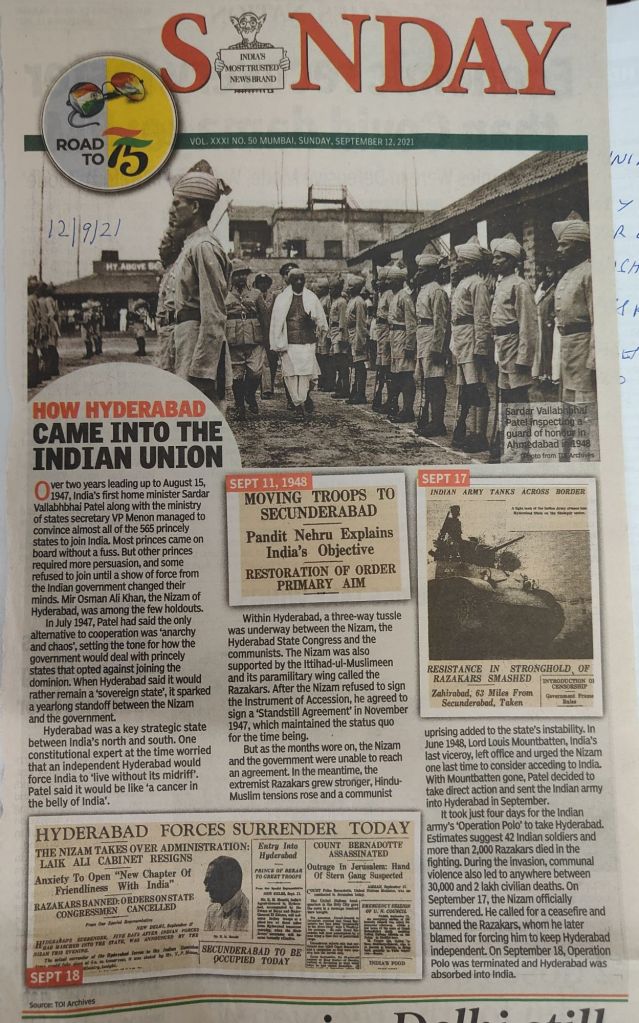
Over two years leading up to August 15, 1947, India’s first home minister, Sardar Vallabhbhai Patel, along with the Ministry of States secretary VP Menon, managed to convince almost all the 565 princely states to join India. Most princes came on board without a fuss. But other princes required more persuasion, and some refused to join until a show of force from the Indian government changed their minds. Mir Osman Ali Khan, the Nizam of Hyderabad, was among the few holdouts.
In July 1947, Patel had said the only alternative to cooperation was ‘anarchy and chaos’, setting the tone for how the government would deal with princely states that opted against joining the dominion. When Hyderabad said it would rather remain a ‘sovereign state’, it sparked a year-long standoff between the Nizam and the government.
Hyderabad was a key strategic state between India’s north and south. One constitutional expert at the time worried that an independent Hyderabad would force India to ‘live without the midriff’. Patel said it would be like ‘a cancer in the belly of India’.
Within Hyderabad, a three-way tussle was underway between the Nizam, the Hyderabad State Congress and the communists. The Nizam was also supported by the Ittihad-ul-Muslimeen and its paramilitary wing called the Razakars. After the Nizam refused to sign the instrument of Accession, he agreed to sign a ‘Standstill Agreement’ in November 1947, which maintained the status quo for the time being.
But as the months wore on, the Nizam and the government were unable to reach an agreement. In the meantime, the extremist Razakars grew stronger, Hindu-Muslim tensions rose and a communist uprising added to the state’s instability. In June 1948, Lord Louis Mountbatten, India’s last viceroy, left office and urged the Nizam one last time to consider acceding to India. With Mountbatten gone, Patel decided to take direct action and sent the Indian army into Hyderabad in September.
It took just four days for the Indian army’s ‘Operation Polo’ to take Hyderabad. Estimates suggest 42 Indian soldiers and more than 2,000 Razakars died in the fighting. During the invasion, communal violence also led to anywhere between 30,000 and 2 lakh civilian deaths. On September 17, the Nizam officially surrendered. He called for a ceasefire and banned the Razakars, whom he later blamed for forcing him to keep Hyderabad independent. On September 18, Operation Polo was terminated, and Hyderabad was absorbed into India.
MAIN POINTS
- SEPTEMBER 11, 1948,
- Moving troops to Secunderabad.
- Pandit Nehru Explains India’s Objective
- Restoration of Order: Primary Aim
- SEPTEMBER 17, 1948
- Indian Army Tanks Cross Border
- Resistance in the Stronghold of Razakars Smashed
Times of India 12.9.21
Posted by Kamlesh Tripathi
Author, Poet, & Columnist
*
https://kamleshsujata.wordpress.com
*
Like it and Share it
*
Shravan Charity Mission is an NGO that works for poor children suffering from life-threatening diseases, especially cancer. Our posts are meant for our readers, including children and adults, and have a huge variety of content. We also accept donations for our mission. Should you wish to donate to the cause of cancer? The bank details are given below:
NAME OF ACCOUNT: SHRAVAN CHARITY MISSION
Account no: 680510110004635 (BANK OF INDIA)
IFSC code: BKID0006805
***
 Shravan charity mission