Copyright@shravancharitymission
Ancient Egypt has always been an enigma. If you peek into the past, it took Howard Carter years of research before he found Tutankhamun’s tomb. The door of this tomb had been closed for almost 3,000 years. It contained treasures. Its discovery exhibited one of the greatest civilisations in history.
The Nile is one of the longest rivers in the world. Egypt is a hot and dry desert. The Nile flows right through it. It used to flood Egypt every year. The flood water, left behind thick soil called silt. It was good for growing crops. People settled along the Nile more than 7,500 years ago. To keep track of planting, they designed a calendar based on the Nile’s annual flood pattern. The calendar had a year of 365 days divided into 12 months and three seasons. We use this calendar even today.
The Egyptians used the Nile as a highway. Their boats sailed up and down the river. They carried merchandise to trade in other countries. Gradually ancient Egypt grew into a powerful civilisation. It was one of the most powerful in the history of the world. It lasted for nearly 3,000 years, from 3150 B.C. to 30 B.C.
The rulers of ancient Egypt were called pharaohs. People believed that the pharaoh was their God on Earth. He or she was all-powerful and made all the laws of the land. They owned the land and everything on it. They also ensured that the Pharaoh appeared young and fit, no matter how he or she looked in real life.
Ramses II was one of ancient Egypt’s most important Pharaohs. He ruled for 65 years and built more monuments than any other king before him. Tutankhamun only ruled for 10 years. But he’s famous because he was buried with more than 5,000 treasures like thrones, jewellery, a gold coffin, and a chariot.
Most pharaohs were men, but not all. For a long time, the experts didn’t know that pharaoh Hatshepsut was a woman. That’s because she ordered statues and paintings to show her as a man with a beard and taut muscles.
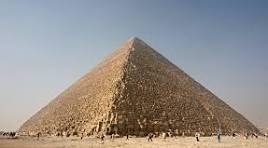
Some pharaohs ordered massive structures called pyramids to be built. The pyramids graced the pharaohs. One was the Great Pyramid of Khufu at Giza. It was the tallest structure in the world for more than 3,800 years. It was 481 feet tall and took 20 years to build. The Egyptians created the Great Sphinx to guard the pyramids. A sphinx is a made-up creature with a lion’s body and a human head. Egyptians carved sphinx statues to guard important areas.
The workers who built the pyramids did not have machines. Experts feel they cut huge stone blocks from quarries. They were then dragged to the boats and floated down the Nile. Thereafter, they hauled the stone blocks up the ramps and placed them on the pyramid. In 1999, an ancient town near the pyramids was discovered. Long ago, this town was home to workers who built the pyramids. The area was bigger than 10 football fields. The pyramids weren’t just buildings. They were tombs. A Pharaoh was buried in each of the large pyramids. Smaller pyramids nearby held the bodies of their family members.
Not all mummies were human beings. Egyptians sometimes made mummies of animals too, like cats. Mummies of dogs, hawks, and even crocodiles have also been discovered. The body of a human or an animal that has been dried and wrapped before burial is called mummies.
Egyptians believed in life after death. They wanted to make sure their dead relatives would have everything they might need in the afterlife. So they stocked their tombs with food, clothes, furniture, and jewellery.
The experts felt that the first mummies were made by accident. Egyptians buried their dead in the desert. The hot and dry sand killed the bacteria that caused the body to break down. So instead of rotting, the bodies dried out. Not everyone was mummified. The process was so expensive that only the wealthy could afford it. The Egyptians believed that if a person’s body was preserved, his or her soul would live forever. So they studied these natural mummies. They learned how to make bodies last for centuries. This process was called mummification.
To make a mummy, ancient Egyptians would insert a hook into the dead person’s nose, pull out the brain, and throw it away. Then they removed the liver, stomach, intestines, and lungs. They sealed them in canopic jars (special containers). The heart was left in place. Egyptians didn’t think the brain was important. They thought the heart was the source of wisdom. Next, they would pack the body with natron, a type of salt, to soak up moisture. The body was then left for 40 days after which the natron was removed from the dried body, and the body was filled with rags to shape it. Finally, the body was wrapped in layers of linen. An Egyptian mummy now lies in the National Archaeological Museum in Madrid, Spain.
After a person died, Egyptians believed that he or she would travel to the next world and appear before the god Osiris. Osiris was the judge and lord of the dead. The person’s heart would then be weighed on a golden scale against a feather, called the feather of truth. If the heart weighed less than the feather, the person could live on forever in paradise. The wolf-headed god Anubis weighed the heart. The demon Ammut with a crocodile head waited to see if the heart was judged unworthy. If so, he would eat it up.
Some interesting facts about Egyptians: The Egyptians thought many animals were connected with the gods, from cats to cobras, to crocodiles. Many ancient Egyptians shaved their heads. They did this to keep lice away and stay cool in the heat. They often wore wigs to cover their bald heads. The Egyptians grew a lot of grain. Bread and porridge were the main meals of most people. Many mummies wore masks made to look like the faces of the dead. That way the dead person’s spirit could find its body again. Of the seven big, important structures from history called the “wonders of the ancient world,” the Great Pyramid is the only one still standing. The Egyptians invented makeup. Both men and women wore it. They believed that wearing makeup gave them the protection of the gods.
Gods and Goddesses were important in the everyday lives of ancient Egyptians. The Egyptians believed in more than 2,000 of them. They had a god for everything, from daily chores to a safe journey to the afterlife. Each one needed to be worshipped. Horus was the god of the sky. Horus had a falcon-head. In each claw, he holds an ankh, the symbol of life. The god of Thoth had the head of an ibis, a type of bird that once lived in Egypt. Thoth was the god of writing and science. Bes protected Egyptian families from snakes and scorpions. The Egyptians thought the god Bes also scared away demons.
Ancient Egyptians thought illness happened when the gods got angry. Doctors used spells to drive away demons. But they had medicine, too. Some didn’t work, like an eye cream that included bat blood. But other medicines did. Many medicines included honey, a natural germ-killer. From the making of mummies, the Egyptians learned a lot about how the body worked. Egyptian doctors could stitch wounds, heal broken bones, and perform minor surgeries using blades. The first female doctor was an ancient Egyptian named Peseshet. She practiced medicine when the great pyramids were built, around 2500 B.C.
The Egyptians weren’t just ahead of their time in medicine. They also knew a lot about math. They had to: Otherwise, their tombs and temples would have toppled without it. The temple of Hatshepsut was designed so that the rising winter sun would shine on the statue inside. They invented a number system based on zeros and ones that are still used to program today’s computers.
They also studied the movement of the sun, moon, and stars. The Great Pyramid’s four sides exactly face north, south, east, and west. Many Egyptian temples are aligned along the path of the rising sun.
Egyptian craftsmen made beautiful paintings, sculptures, jewellery, and furniture. They filled the tombs of loved ones with these treasures. Art gives us clues about what life was like in ancient Egypt. It shows how people dressed. It also shows what kinds of jobs they had and what they did for fun.
The ancient Egyptians loved board games. Some pharaohs were even buried with their favourite games.
Posted by Kamlesh Tripathi
*
https://kamleshsujata.wordpress.com
*
Like it and Share it
*
Shravan Charity Mission is an NGO that works for poor children suffering from life-threatening diseases, especially cancer. Our posts are meant for our readers, including children and adults, and have a huge variety in content. We also accept donations for our mission. Should you wish to donate to the cause? The bank details are given below:
NAME OF ACCOUNT: SHRAVAN CHARITY MISSION
Account no: 680510110004635 (BANK OF INDIA)
IFSC code: BKID0006805
*
Kamlesh Tripathi’s Publications
GLOOM BEHIND THE SMILE
(The book is about a young cancer patient. Now archived in 8 prestigious libraries of the US which include Harvard College Library; Harvard University Library; Library of Congress; University of Washington, Seattle; University of Minnesota, Minneapolis; Yale University, New Haven; University of Chicago; University of North Carolina, at Chapel Hill University Libraries. It can also be accessed at MIT through Worldcat.org. Besides, it is also available for reading in libraries and archives of Canada; Cancer Aid and Research Foundation Mumbai; Jaipuria Institute of Management, Noida, India; Shoolini University, Yogananda Knowledge Center, Himachal Pradesh and Azim Premzi University, Bangalore).
ONE TO TANGO … RIA’S ODYSSEY
(Is a book on ‘singlehood’ about a Delhi girl now archived in Connemara Library, Chennai and Delhi Public Library, GOI, Ministry of Culture, Delhi; It is also available for reading in the Indian National Bibliography, March 2016, in the literature section, in Central Reference Library, Ministry of Culture, India, Belvedere, Kolkata-700022)
AADAB LUCKNOW … FOND MEMORIES
(Is a fiction written around the great city of Nawabs—Lucknow. It describes Lucknow in great detail and also talks about its Hindu-Muslim amity, which is the undying characteristic of Lucknow. The book was launched at the Lucknow International Literary Festival in 2014. It is included for reading in Askews and Holts Library Services, Lancashire, U.K; Herrick District Library, Holland and Charlotte-Mecklenburg Library, Mecklenburg County in North Carolina, USA; Black Gold Cooperative Library Administration, Arroyo Grande, California; Berkeley Library, University of California).
REFRACTIONS … FROM THE PRISM OF GOD
(Co-published by Cankids–Kidscan, a pan India NGO and Shravan Charity Mission, that works for child cancer in India. The book is endorsed by Ms Preetha Reddy, MD Apollo Hospitals Group. It was launched at the Lucknow International Literary Festival in 2016).
TYPICAL TALE OF AN INDIAN SALESMAN
(Is a story of an Indian salesman who is, humbly qualified. Yet he fights his way through unceasing uncertainties to reach the top. A good read not only for salesmen. The book was launched on 10th February 2018 at Gorakhpur Lit-Fest. Now available on Amazon, Flipkart and Onlinegatha)
RHYTHM … in poems
(Published in January 2019. The book contains 50 poems. The poems describe our day-to-day life. A few poems from the book have been published in Shillong Times, Bandra Times and Bhavan’s Journal. The book is available on Amazon, Flipkart and Onlinegatha)
MIRAGE
(Published in February 2020. The book is a collection of eight short stories available on Amazon, Flipkart and Notion Press)
AWADH ASSAM AND DALAI LAMA … The Kalachakra
(The story of the man who received His Holiness The Dalai Lama and his retinue in 1959 as a GOI representative when he fled Tibet in 1959. The book was launched on 21st November 2022 by His Holiness The Dalai Lama at Dharmshala. The title is archived in the library of the Department of Information and International Relations (DIIR) Government of Tibet, Tibet Policy Institute (TPI) and the personal library of His Holiness The Dalai Lama. The title is also archived in The Ohio Digital Library, USA. It was recently included in the digital library of the world-renowned company APPLE).
BHAVANS JOURNAL
Short stories, Book reviews and Articles published in Bhavan’s Journal: 1. Reality and Perception, 15.10.19; 2. Sending the Wrong Message, 31.5.20; 3. Eagle versus Scholars June, 15 & 20, 2020; 4. Indica, 15.8.20; 5. The Story of King Chitraketu, August 31 2020; 6. Breaking Through the Chakravyuh, September 30 2020. 7. The Questioning Spouse, October 31, 2020; 8. Happy Days, November 15, 2020; 9. The Karma Cycle of Paddy and Wheat, December 15, 2020; 10. Power Vs Influence, January 31, 2021; 11. Three Refugees, March 15, 2021; 12. Rise and Fall of Ajatashatru, March 31, 2021; 13. Reformed Ruler, May 15, 2021; 14. A Lasting Name, May 31, 2021; 15. Are Animals Better Teachers? June 16, 2021; 16. Book Review: The Gram Swaraj, 1.7.21; 17. Right Age for Achievements, 15.7.21; 18. Big Things Have Small Beginnings, 15.8.21; 19. Where is Gangaridai?, 15.9.21; 20. Confront the Donkey Within You 30.9.21; 21. Know Your Strengths 15.10.21; 22. Poverty 15.11.21; 23. Top View 30.11.21; 24. The Bansuriwala 15.1.22; 25. Sale of Alaska 15.2.22; 26. The Dimasa Kingdom 28.2.22; 27. Buried Treasure 15.4.22; 28. The Kingdom of Pragjyotisha 30.4.22; 29. Who is more useful? 15.5.22; 30. The White Swan from Lake Mansarovar 30.6.22; 31. Bhool Bhulayya 15.9.22; 32. Good Karma 30.9.22; 33. Good Name vs Bad Name 15.10.22; 34. Uttarapath—The Grand Trunk Road 1.12.22; 35. When Gods Get Angry 1.1.23; 36. Holinshed’s Chronicles 15.1.23; 37. Theogony 15.2.23; 38. Poem: Mother 14.5.23; 39. THE NAG MANDIR 30.6.23; 40. The Story of Garuda 30.7.23; 41. Janmabhoomi vs Karmabhoomi 31.8.23; 42. The Ghost Town of Kuldhara 15.9.23; 43. The Tale of Genji 15.10.23; 44. The Soul Connection 1.12.23;
SHILLONG TIMES—SUNDAY EDITION
ARTICLES & POEMS: 1. POEM: HAPPY NEW YEAR 8.1.23; 2. POEM: SPRING 12.3.23; 3. POEM: RIGHT AND WRONG 20.3.23; 4. THE GUSH OF EMOTION—WRITING, 26.3.23; 5. THE NAG MANDIR, 7.5.23; 6. POEM: MOTHER 7.5.23; 7. POEM: RAIN RAIN 9.7.23; 8. POEM: YOU COME ALONE YOU GO ALONE 6.8.23; 9. RAIN RAIN (SECOND TIME) 10.8.23; 10. POEM: GURU TEACHER 10.8.23; 11. POEM: AUTUMN … THE INTERIM HEAVEN 15.10.23; 12. POEM: HAPPY DIWALI 12.11.23; 13. OVERCOMING BLINDNESS: LEARN IT THE JOHN MILTON WAY 10.12.23; 14. THE HAPPY PRINCE AND THE HAPPY MAN’S SHIRT 31.12.23
THE ASSAM TRIBUNE
ARTICLE: 1. THE MAGIC OF READING 11.12.23
BANDRA TIMES, MUMBAI
ARTICLES & POEMS: 1. POEM: SPRING, 1.4.23; 2. POEM: MOTHER, 1.6.23; 3. POEM: RAIN RAIN, 1.8.23;
ARTICLES IN THE DIGITAL MAGAZINE ESAMSKRITI
29.12.2020: INDICA BY MEGASTHENES; 14.3.22: ABOUT THE DIMASA KINGDOM ASSAM; 10.12.22: GRAND TRUNK ROAD-UTTARAPATH; 5.10.23: THE GHOST TOWN OF KULDHARA NEAR JAISALMER;
(ALL THE ABOVE BOOK TITLES ARE AVAILABLE FOR SALE ON AMAZON, FLIPKART AND OTHER ONLINE STORES OR YOU COULD EVEN WRITE TO US FOR A COPY)
*****
 Shravan charity mission