Tag Archives: Hebrew Bible

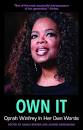
BOOK REVIEW: ‘OWN IT … Oprah Winfrey In Her Own Words.’ Edited by Anjali Becker and Jeanne Engelmann.

Copyright@shravancharitymission

Khidki (Window)

–Read India Initiative—

This is only an attempt to create interest in reading. We may not get the time to read all the books in our lifetime. But such reviews, talk and synopsis will at least convey what the book is all about.

    In these tough times of Corona Virus when there is a complete lockdown, it is indeed the best time to go through all the book reviews that I’ve done. You’ll find them all in my blog. 

    I’m sure you must have heard the name of Oprah Winfrey.  Well!! I’ve been able to lay my hands on a book titled ‘OWN IT … Oprah Winfrey In Her Own Words.’ It is edited by Anjali Becker and Jeanne Engelmann.

    There is something about her name that I must tell you upfront. Orpah Gail Winfrey (the Biblical “Orpah” mentioned in the Book of Ruth in the Hebrew Bible was mispronounced as “Oprah” and the name stuck on to her).   

    Before I head out to tell you about the book let me first give you a brief introduction of Oprah Gail Winfrey. ‘One of the most successful entrepreneurs of her generation.’ says Forbes. Oprah was born on January 29, 1954. She happens to be an American media executive, actress, talk show host, television producer and a philanthropist. She is best known for her talk show ‘The Oprah Winfrey Show’ broadcasted from Chicago. It was the highest-rated television program of its kind in the history and ran in national syndication for 25 years from 1986 to 2011. Dubbed the “Queen of All Media” she was the richest African-American of the 20th century and North America’s first black multi-billionaire. She is also ranked as the greatest black philanthropist in American history. By the year 2007, she was often ranked as the most influential woman in the world.

    Winfrey was born in poverty in rural Mississippi to a single teenage mother and later raised in inner-city Milwaukee, Wisconsin. She has confessed that she was molested during her childhood and in her early teens and became pregnant at the age of 14. Her son was born premature and died in infancy. Winfrey was then sent to live with the man she calls her father, Vernon Winfrey, a barber in Tennessee, and landed with a job in radio while still in high school. By 19, she was a co-anchor for the local evening news. Winfrey’s, often emotional, extemporaneous delivery, eventually led, to her transfer, to the daytime talk show arena, and after having boosted a third-rated, local, Chicago talk show, to first place, she launched her own production company and became internationally syndicated.

    Credited with creating a more intimate, confessional form of media communication, Winfrey popularized and revolutionized, the tabloid talk show genre, pioneered by Phil Donahue. Through this medium, Winfrey broke 20th-century taboos and allowed LGBT (Lesbian, Gay, Bi-sexual & Transgender) people to enter the mainstream through television appearances. In 1994, she was inducted into the National Women’s Hall of Fame.

    By the mid-1990s, Winfrey had reinvented her show with a focus on literature, self-improvement, mindfulness, and spirituality. Though she was criticized for unleashing a confession culture, promoting controversial self-help ideas, and having an emotion-centered approach, she was also praised for overcoming adversity to become a benefactor to others. Winfrey had also emerged as a political force in the 2008 presidential race, delivering about one million votes to Barack Obama in the razor close 2008 Democratic primary. In 2013, Winfrey was awarded the Presidential Medal of Freedom by President Obama and an honorary doctorate degree from Duke and Harvard. In 2008, she formed her own network, Oprah Winfrey Network (OWN).

    The title book ‘Own it’ is quite a disappointment. It hardly has any, so called editors’ contribution barring a short flat introduction. The total number of pages, in the book are 144, plus the table of contents. It is just a series of bland, quote after quote, presumably uttered by Oprah herself, during her long prolific career. The book doesn’t even have a proper introduction or a foreword by Oprah. The publisher is, An Agate Imprint.

    The editors have divided the quotes into eight chapters namely Preperation/Risk Taking/Decision Making/Challenges/Work-life balance/Leadership/Mission-Vision and Philanthropy/Oprah’s achievements. In addition there is a chapter each on milestones and citations.

    The editors have not made any introductory sentences to link the quotes. The title of the book states, ‘in her own words’ which in fact is somewhat deceiving. The book is all about words that Oprah might have spoken, but it is not written by Oprah.

    The book doesn’t have much to offer. In fact I liked the ‘milestone’ a chapter at the rear of the book better than the main book. It describes her life in pointers from 1954 to 2016.

    Let me spell out a few quotes that I liked out of the book:

    Here is one on Ratings

    ‘I don’t do anything just for ratings, but as I’ve said, we’re in the television business. If you all are not watching this, if this does not attract your attention, then that means we have not succeeded in doing what we’re supposed to do as a business. So am I looking for people I am interested in and also that I believe the public is interested in, our viewers? Of course. And does that equal ratings? I hope so.

   On Being Grateful there is a quote that I liked.

Opportunities, relationships, even money flowed my way when I learned to be grateful no matter what happened in my life.

On Leading by Example

    It appears Oprah believed in Mahatma Gandhi. I can figure that out when she talks about leading by Example … Become the change you want to see—those are words I live by (a quote of Mahatma Gandhi). She goes on to say: Instead of belittling, uplift. Instead of demolishing, rebuild. Instead of misleading, light the way so that all of us can stand on higher ground.

    My rating five out of ten.    

By Kamlesh Tripathi

*

https://kamleshsujata.wordpress.com

*

Share it if you like it

*

Shravan Charity Mission is an NGO that works for poor children suffering from life threatening diseases especially cancer. Our posts are meant for our readers that includes both children and adults and it has a huge variety in terms of content. We also accept donations for our mission. Should you wish to donate for the cause. The bank details are given below:

NAME OF ACCOUNT: SHRAVAN CHARITY MISSION

Account no: 680510110004635 (BANK OF INDIA)

IFSC code: BKID0006805

*

Our publications

GLOOM BEHIND THE SMILE

(The book is about a young cancer patient. Now archived in 7 prestigious libraries of the US, including, Harvard University and Library of Congress. It can also be accessed in MIT through Worldcat.org. Besides, it is also available for reading in Libraries and archives of Canada and Cancer Aid and Research Foundation Mumbai)  

ONE TO TANGO … RIA’S ODYSSEY

(Is a book on ‘singlehood’ about a Delhi girl now archived in Connemara Library, Chennai and Delhi Public Library, GOI, Ministry of Culture, Delhi)

AADAB LUCKNOW … FOND MEMORIES

(Is a fiction written around the great city of Nawabs—Lucknow. It describes Lucknow in great detail and also talks about its Hindu-Muslim amity. That happens to be its undying characteristic. The book was launched in Lucknow International Literary Festival of 2014)

REFRACTIONS … FROM THE PRISM OF GOD

(Co-published by Cankids–Kidscan, a pan India NGO and Shravan Charity Mission, that works for Child cancer in India. The book is endorsed by Ms Preetha Reddy, MD Apollo Hospitals Group. It was launched in Lucknow International Literary Festival 2016)

TYPICAL TALE OF AN INDIAN SALESMAN

(Is a story of an Indian salesman who is, humbly qualified. Yet he fights his ways through unceasing uncertainties to reach the top. A good read not only for salesmen. The book was launched on 10th February, 2018 in Gorakhpur Lit-Fest. Now available in Amazon, Flipkart and Onlinegatha)

RHYTHM … in poems

(Published in January 2019. The book contains 50 poems. The poems describe our day to day life. The book is available in Amazon, Flipkart and Onlinegatha)

MIRAGE

(Published in February 2020. The book is a collection of eight short stories. It is available in Amazon, Flipkart and Notion Press)

(ALL THE ABOVE TITLES ARE AVAILABLE FOR SALE IN AMAZON, FLIPKART AND OTHER ONLINE STORES OR YOU COULD EVEN WRITE TO US FOR A COPY)

*****


INTERESTING FACTS FIGURES & QUOTES-46–ARAB ISRAEL CONFLICT

Copyright@shravancharitymission

   Arab-Israel war is an age old holy war. The conflict is primordial.

    The contemporary history of the Arab–Israeli conflict is very much affected by the religious beliefs of the two sides, and their views of the idea of the chosen people. (Now what is chosen people? Throughout History, various groups of people have considered themselves to be the chosen people or a deity’s extension on earth. In monotheistic faiths, that believes in only one God, references to God are used in constructs such as chosen people). In this context it is their policies with regard to the “Promised Land” and the “Chosen City” of Jerusalem.

    The Land of Canaan or Eretz Yisrael  (Land of Israel), according to the Hebrew Bible, was promised by God to the Children of Israel. This is also mentioned in the Quran. (Sura 17, in the night journey verse). In his 1896 manifesto, The Jewish State’s, Theodor Herzl repeatedly refers to the Biblically Promised Land concept.  (Theodor Herzl is a Jewish, Astro-Hungarian, journalist, playwright, political activist, and writer who was the father of modern Zionism, and formed the Zionist organization). Likud is currently the most prominent Israeli political party to include the Biblical claim to the Land of Israel in its platform.

    Muslims also claim rights to that land in accordance with the Quran. Contrary to the Jewish claim that this land was promised only to the descendants of Abraham’s grandson Jacob (that is Yisrael), (Just for reference Abraham is the common patriarch of Christianity, Islam, Judaism, and some other religions. In Judaism (the religion of Jews) Abraham is the founding father of the covenant (the agreement) of the pieces, the special relationship between the Hebrews and God. (In Christianity he is the prototype of all believers) (Jacob, the grandson of Abraham was later given the name Israel, and is regarded as the patriarch of Israelites and so is an important figure in Abrahamic religions, such as Judaism, Christianity and Islam. Jacob first appears in the book of Genesis, (the first book of Hebrew Bible) as the son of Isaac and Rebecca and the grandson of Abraham). The Arabs argue that the Land of Canaan was promised to what they consider the elder son of Abraham, Ishmael, from whom Arabs claim descent. Additionally, Muslims also revere, many sites, holy for Biblical Israelites, such as the Cave of the Patriarchs and the Temple Mount. In the past 1,400 years, Muslims have constructed Islamic landmarks on these ancient Israelite sites, such as the Dome of the Rock and the Al-Aqsa-Mosque on the Temple Mount, the holiest site in Judaism. This has brought the two groups into conflict over the rightful possession of Jerusalem. Muslim teaching is that Muhammad passed through Jerusalem on his first journey to heaven. 

    Then we have Hamas, that governs the Gaza Strip (Hamas is a Palestinian Sunni Islamic fundamentalist militant organization. It has a social service wing, Dawah, and a military wing, called the Izz-ad din-al-Qassam Brigades. It has been the de-facto governing authority of Gaza Strip since its takeover of that area in 2007). (The Gaza Strip, or simply Gaza, is a self-governing Palestinian territory on the eastern coast of the Mediterranean Sea that borders Egypt on the southwest for 11 km an Israel on the east and north along a 51 km border. Gaza and West Bank are cleared by the de-jure claims that all of the land of Palestine (which is the current Israeli and Palestinian territories) is an Islamic Waqf that must be governed by the Muslims.

    Now let’s come to Christian Zionists. Christian Zionism is a belief among some Christians that the return of the Jews to the holy land and the establishment of the state of Israel in 1948 were in accordance with the Bible prophecy. The term began to be used in the mid-20th century, superseding Christian Restorationism that often supports the State of Israel because of the ancestral right of the Jews to the Holy Land, as suggested, for instance, by the apostle Paul.

    Paul the apostle commonly known as Saint Paul and also known by his Hebrew name Saul of Taurus, was an apostle (disciple of Jesus) who taught the gospel of Christ to the first century world. Paul is generally considered one of the most important figures of the apostolic age. Christian Zionism teaches that the return of Jews to Israel is a prerequisite for the Second Coming of Christ.

    The roots of the modern, Arab–Israeli conflict, lie in the rise of Zionism and the reactionary Arab nationalism that arose in response to Zionism towards the end of the 19th century. Territory regarded by the Jewish people as their historical homeland is also regarded by the Pan-Arab movement as historically and presently belonging to the Palestinian Arabs. Before World War I, the Middle East, including Palestine (later Mandatory Palestine a geopolitical entity established between 1920 and 1948 in the region of Palestine under the terms of the Mandate for Palestine), had been under the control of the Ottoman Empire for nearly 400 years. During the closing years of their empire, the Ottomans began to espouse their Turkish ethnic identity, asserting the primacy of Turks within the empire, leading to discrimination against the Arabs. The promise of liberation from the Ottomans led many Jews and Arabs to support the allied powers during World War I, leading to the emergence of widespread Arab nationalism. Both Arab nationalism and Jewish Zionism had their formulative beginning in Europe. The Zionist Congress was established in Basel, Switzerland in 1897, while the “Arab Club” was established in Paris in 1906.

    In the late 19th century European and Middle Eastern Jewish communities began to increasingly immigrate to Palestine and purchase land from the local Ottoman landlords. The population of the late 19th century in Palestine reached 600,000 – mostly Muslim Arabs, but also significant minorities of Jews, Christians, Druze (sect of Islam) and some Samaritans and Bahai’s. At that time, Jerusalem did not extend beyond the walled area and had a population of only a few tens of thousands. Communal settlement called kibbutz, were established, as was the first entirely Jewish city Tel Aviv in modern times.

    During 1915–16, as World War I was underway, the British High Commissioner in Egypt, Sir Henry McMahon, secretly corresponded with Husayn-ibn-Ali, the patriarch of the Hashemite family (the Jordan royals) and Ottoman governor of Mecca and Medina. McMahon convinced Husayn to lead an Arab revolt against the Ottoman Empire, which was aligned with Germany against Britain and France in the war. McMahon promised that if the Arabs supported Britain in the war, the British government would support the establishment of an independent Arab state under Hashemite rule in the Arab provinces of the Ottoman Empire, including Palestine. The Arab revolt, led by T.E. Lawrence (“Lawrence of Arabia”) and Husayn’s son Faysal, was successful in defeating the Ottomans, and Britain took control over much of this area.

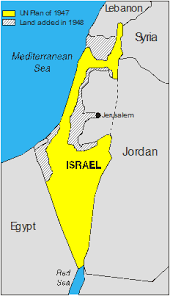
    The Arab-Israeli War of 1948 broke out when five Arab nations invaded the territory in the former Palestinian mandate, immediately, following the announcement of the independence of the state of Israel on May 14, 1948. In 1947, and again on May 14, 1948, the United States had offered a de-facto recognition of the Israeli Provisional Government, but during the war, the United States maintained an arms embargo against all belligerents.

    On November 29, 1947, the United Nations General Assembly adopted Resolution 181 (also known as the Partition Resolution) that would divide Great Britain’s former Palestinian mandate into Jewish and Arab states in May 1948. Under the resolution, the area of religious significance surrounding Jerusalem would remain under international control administered by the United Nations. The Palestinian Arabs refused to recognize this arrangement, which they regarded as favourable to the Jews and unfair to the Arab population that would remain in Jewish territory under the partition. The United States sought a middle way by supporting the United Nations resolution, but also encouraged negotiations between Arabs and Jews in the Middle East.

    The United Nations resolution sparked conflict between Jewish and Arab groups within Palestine. Fighting began with attacks by irregular bands of Palestinian Arabs attached to local units of the Arab Liberation Army composed of volunteers from Palestine and neighbouring Arab countries. These groups launched their attacks against Jewish cities, settlements, and armed forces. The Jewish forces were composed of the Haganah, the underground militia of the Jewish community in Palestine, and two small irregular groups, the Irgun, and LEHI. The goal of the Arabs was initially to block the Partition Resolution and to prevent the establishment of the Jewish state. The Jews, on the other hand, hoped to gain control over the territory allotted to them under the Partition Plan.

    After Israel declared its independence on May 14, 1948, the fighting intensified with other Arab forces joining the Palestinian Arabs in attacking the territory in the former Palestinian mandate. On the eve of May 14, the Arabs launched an air attack on Tel Aviv, which the Israelis resisted. This action was followed by the invasion of the former Palestinian mandate by Arab armies from Lebanon, Syria, Iraq, and Egypt. Saudi Arabia sent a formation that fought under the Egyptian command. British trained forces from Trans-jordan eventually intervened in the conflict, but only in areas that had been designated as part of the Arab state under the United Nations Partition Plan and the Corpus-Separatum of Jerusalem in 1947. After tense early fighting, Israeli forces, under joint command, were able to gain the offensive.

    Though the United Nations brokered two cease-fires during the conflict, fighting continued into 1949. Israel and the Arab states did not reach any formal armistice agreements until February. Under separate agreements between Israel and the neighboring states of Egypt, Lebanon, Transjordan, and Syria, these bordering nations agreed to a formal armistice lines. Israel gained some territory formerly granted to Palestinian Arabs under the United Nations resolution in 1947. Egypt and Jordan retained control over the Gaza Strip and the West Bank respectively. These armistice lines were held until 1967. The United States did not become directly involved with the armistice negotiations, but hoped that instability in the Middle East would not interfere with the international balance of power between the Soviet Union of those times and the United States.

By Kamlesh Tripathi

*

https://kamleshsujata.wordpress.com

*

Share it if you like it

*

Shravan Charity Mission is an NGO that works for poor children suffering from life threatening diseases especially cancer. Our posts are meant for our readers that includes both children and adults and it has a huge variety in terms of content. We also accept donations for our mission. Should you wish to donate for the cause. The bank details are given below:

NAME OF ACCOUNT: SHRAVAN CHARITY MISSION

Account no: 680510110004635 (BANK OF INDIA)

IFSC code: BKID0006805

*

Our publications

GLOOM BEHIND THE SMILE

(The book is about a young cancer patient. Now archived in 7 prestigious libraries of the US, including, Harvard University and Library of Congress. It can also be accessed in MIT through Worldcat.org. Besides, it is also available for reading in Libraries and archives of Canada and Cancer Aid and Research Foundation Mumbai)  

ONE TO TANGO … RIA’S ODYSSEY

(Is a book on ‘singlehood’ about a Delhi girl now archived in Connemara Library, Chennai and Delhi Public Library, GOI, Ministry of Culture, Delhi)

AADAB LUCKNOW … FOND MEMORIES

(Is a fiction written around the great city of Nawabs—Lucknow. It describes Lucknow in great detail and also talks about its Hindu-Muslim amity. That happens to be its undying characteristic. The book was launched in Lucknow International Literary Festival of 2014)

REFRACTIONS … FROM THE PRISM OF GOD

(Co-published by Cankids–Kidscan, a pan India NGO and Shravan Charity Mission, that works for Child cancer in India. The book is endorsed by Ms Preetha Reddy, MD Apollo Hospitals Group. It was launched in Lucknow International Literary Festival 2016)

TYPICAL TALE OF AN INDIAN SALESMAN

(Is a story of an Indian salesman who is, humbly qualified. Yet he fights his ways through unceasing uncertainties to reach the top. A good read not only for salesmen. The book was launched on 10th February, 2018 in Gorakhpur Lit-Fest. Now available in Amazon, Flipkart and Onlinegatha)

RHYTHM … in poems

(Published in January 2019. The book contains 50 poems. The poems describe our day to day life. The book is available in Amazon, Flipkart and Onlinegatha)

(ALL THE ABOVE TITLES ARE AVAILABLE FOR SALE IN AMAZON, FLIPKART AND OTHER ONLINE STORES OR YOU COULD EVEN WRITE TO US FOR A COPY)

*****