13/4/25 BACK TO MODERN TIMES: THE NEW OBSESSION WITH LONGER WORK DAYS
ABHIJIT BANNERJEE
TASTING ECONOMICS
TIMES OF INDIA 13/4/25
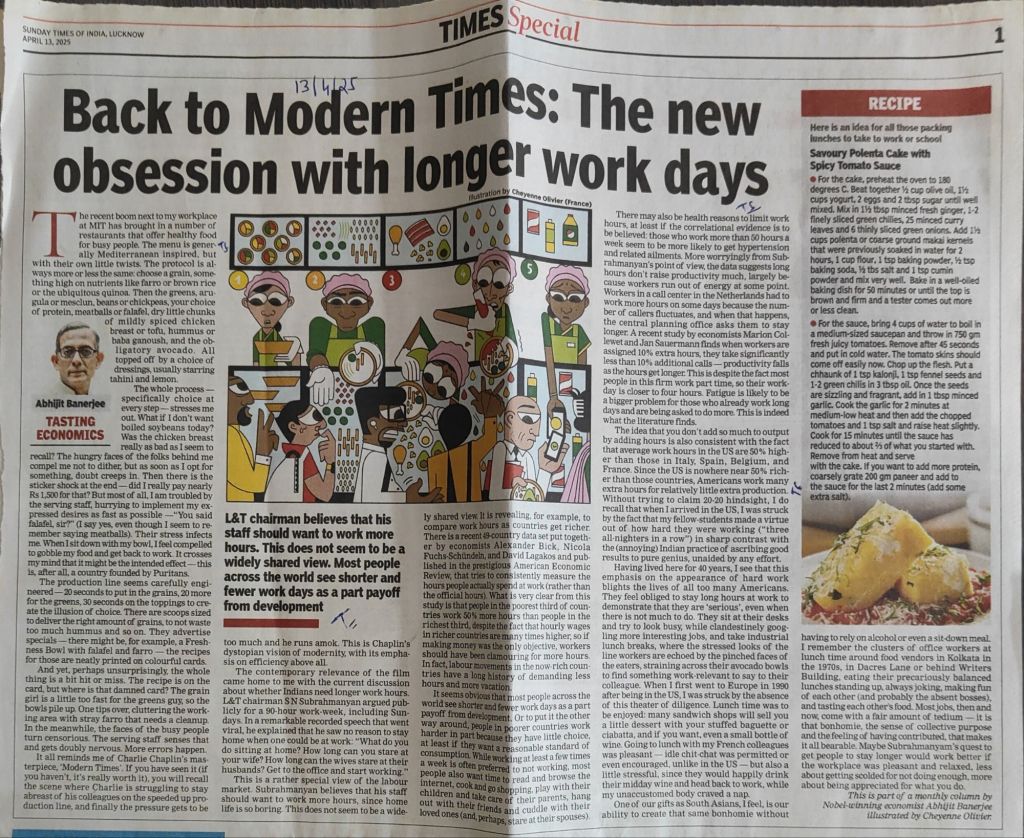
The recent book next to my workplace at MIT has brought in a number of restaurants that offer healthy food for busy people. The menu is generally Mediterranean inspired, but with their own little twists. The protocol is always more or less the same: choose a grain, something high on nutrients like farro or brown rice or the ubiquitous quinoa. Then the greens, arugula or mesclun, beans or chickpeas, your choice of protein, meatballs or falafel, dry little chunks of mildly spiced chicken breast or tofu, hummus or baba ganoush, and the obligatory avocado. All topped off by a choice of dressings, usually starring tahini and lemon.
The whole process –specifically choice at every step –stresses me out. What if I don’t want boiled soybeans today? Was the chicken breast really as bad as I seen to recall? The hungry faces of the folks behind me compel me not to dither, but as soon as I opt for something, doubt creeps in. Then there is the sticker shock at the end –did I really pay nearly Rs 1,500 for that? But most of all, I am troubled by the serving staff, hurrying to implement my expressed desires as fast as possible –“You said falafel, sir?” (I say yes, even though I seem to remember saying meatballs). Their stress infects me. When I sit down with my bowl, I feel compelled to gobble my food and get back to work. It crosses my mind that it might be the intended effect –this is, after all, a country founded by Puritans.
The production line seems carefully engineered –20 seconds to put it in the grains, 20 more for the greens, 30 seconds on the toppings to create the illusion of choice. There are scoops sized to deliver the right amount of grains, to not waste too much hummus and so on. They advertise specials –there might be, for example, a Freshness Bowl with falafel and farro–the recipes for those are neatly printed on colourful cards.
And yet, perhaps unsurprisingly, the whole thing is a bit hit or miss. The recipe is on the card, but where is that damned card? The grain girl is a little too fast for the greens guy, so the bowls pile up. One tips over, cluttering the working area with stray farro that needs a cleanup. In the meanwhile, the faces of the busy people turn censorious. The serving staff senses that and gets doubly nervous. More errors happen.
It all reminds me of Charlie Chaplin’s masterpiece, ‘Modern Times’. If you have seen it (if you haven’t, it’s really worth it), you will recall the scene where Charlie is struggling to stay abreast of his colleagues on the speeded up production line, and finally the pressure gets to be too much and he runs amok. This is Chaplin’s dystopian vision of modernity, with its emphasis on efficiency above all.
The contemporary relevance of the film came home to me with the current discussion about whether Indians need longer work hours. L&T chairman SN Subrahmanyan argued publicly for a 90-hour work-week, including Sundays. In a remarkable recorded speech that went viral, he explained that he saw no reason to stay home when one could be at work: “What do you do sitting at home? How long can you stare at your wife? How long can the wives stare at their husbands? Get to the office and start working.”
This is a rather special view of the labour market. Subrahmanyam believes that his staff should want to work more hours, since home life is so boring. This does not seem to be a widely shared view. It is revealing, for example, to compare work hours as countries get richer. There is a recent 48-country data set put together by economists Alexander Bick, Nicola Fuchs-Schundeln, and David Lagakos and published in the prestigious American Economic Review, that tries to consistently measure the hours people actually spend at work (rather than the official hours). What is very clear from this study is that people in the poorest third of countries work 50% more hours than people in the richest third, despite the fact that hourly wages in richer countries are many times higher, so if making money was the only objective, workers should have been clamouring for more hours. In fact, labour movements in the now-rich countries have a long history of demanding less hours and more vacation.
It seems obvious that most people across the world see shorter and fewer work days as a part payoff from development. Or to put it the other way around, people in poorer countries work harder in part because they have little choice, at least if they want a reasonable standard of consumption. While working at least a few times a week is often preferred to not working, most people also want time to read and browse the internet, cook and go shopping, play with their children and take care of their parents, hang out with their friends and cuddle with their loved ones (and, perhaps, stare at their spouses).
There may also be health reasons to limit work hours, atleast if the correlational evidence is to be believed: those who work more than 50 hours a week seem to be more likely to get hypertension and related ailments. More worryingly from Subrahmanyan’s point of view, the data suggests long hours don’t raise productivity much, largely because workers run out of energy at some point. Workers in a call center in the Netherlands had to work more hours on some days because the number of callers fluctuates, and when that happens, the central planning office asks then to stay longer. A recent study by economists Marion Collewet and Jan Sauermann finds when workers are assigned 10% extra hours, they take significantly less than 10% additional calls–productivity falls as the hours get longer. This is despite the fact most people in this firm work part time, so their work-day is closer to four hours. Fatigue is likely to be a bigger problem for those who already work long days and are being asked to do more. This is indeed what the literature finds.
The idea that you don’t add so much to output by adding hours is also consistent with the fact that average work hours in the US are 50% higher than those in Italy, Spain, Belgium and France. Since the US is nowhere near 50% richer than those countries, Americans work many extra hours for relatively little extra production. Without trying to claim 20-20 hindsight, I do recall that when I arrived in the US, I was struck by the fact that my fellow-students made a virtue out of how hard they were working (“three all-nighters in a row”) in sharp contrast with the (annoying) Indian practice of ascribing good results to pure genius, unaided by any effort.
Having lived here for 40 years, I see that this emphasis on the appearance of hard work blights the lives of all too many Americans. They feel obliged to stay long hours at work to demonstrate that they are ‘serious’, even when there is not much to do. They sit at their desks and try to look busy, while clandestinely googling more interesting jobs, and take industrial lunch breaks, where the stressed looks of the line workers are echoed by the pinched faces of the eaters, straining across their avocado bowls to find something work-relevant to say to their colleague. When I first went to Europe in 1990 after being in the US, I was struck by the absence of this theater of diligence. Lunch time was to be enjoyed: many sandwich shops will sell you a little dessert with your stuffed baguette or ciabatta, and if you want, even a small bottle of wine. Going to lunch with my French colleagues was pleasant –idle chit-chat was permitted or even encouraged, unlike in the US–but also a little stressful, since they would happily drink their midday wine and head back to work, while my unaccustomed body craved for a nap.
One of our gifts as South Asians, I feel, is our ability to create that same bonhomie without having to rely on alcohol or even a sit-down meal. I remember the clusters of office workers at lunchtime around food vendors in Kolkata in the 1970s, in Dacres Lane or behind Writers Building, eating their precariously balanced lunches standing up, always joking, making fun of each other (and probably the absent bosses), and tasting each other’s food. Most jobs, then and now, come with a fair amount of tedium –it is that bonhomie, the sense of collective purpose and the feeling of having contributed, that makes it all bearable. Maybe Subrahmanyam’s quest to get people to stay longer would work better if the workplace was pleasant and relaxed, less about getting scolded for not doing enough, more about being appreciated for what you do.
(This is part of the monthly column by Nobel-winning economist Abhijit Banerjee illustrated by Cheyenne Oliver)
***