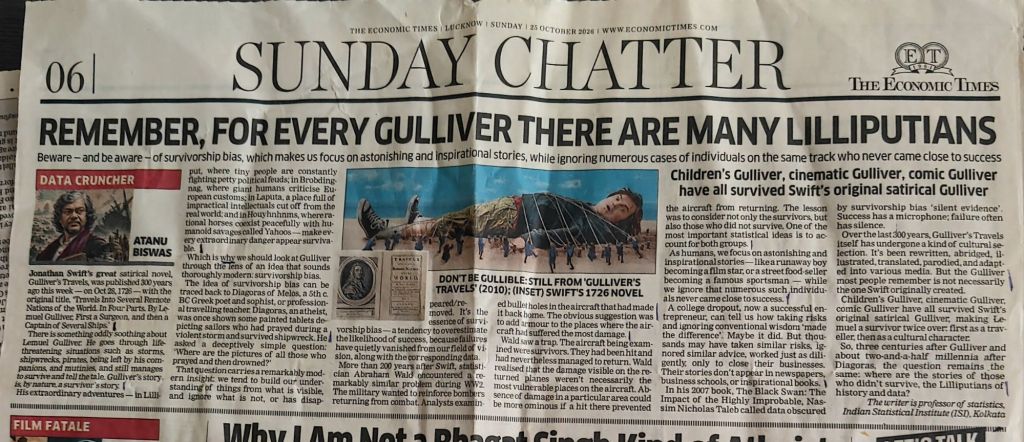
GULLIVER 25/10/26 ECONOMIC TIMES
REMEMBER, FOR EVERY GULLIVER THERE ARE MANY LILLIPUTIANS
“Beware- and be aware – of survivorship bias, which makes us focus on astonishing and inspirational stories, while ignoring numerous cases of individuals on the same track who never came close to success”
Data Cruncher
Atanu Biswas
Jonathan Swift’s great satirical novel, Gulliver’s Travels, was published 300 years ago this week — on Oct 28, 1726– with the original title, ‘Travels Into Several Into Several Remote Nations of the World. In Four Parts. By Lemuel Gulliver, First a Surgeon, and then a Captain of Several Ships.’
There is something oddly soothing about Lemuel Gulliver. He goes through life threatening situations such as storms, shipwrecks, pirates, being left by his companions, and mutines, and still manages to survive and tell the tale. Gulliver’s story is, by nature, a survivor’s story.
His extraordinary adventures — in Lilliput, where tiny people are constantly fighting petty political feuds; in Brobdingnag, where giant humans criticize European customs; in Laputa, a place full of impractical intellectuals cut off from the real world: and in Houyhnhnms, where rational horses coexist peacefully with humanoid savages called Yahoos–make every extraordinary danger appear survivable.
Which is why we should look at Gulliver through the lens of an idea that sounds thoroughly modern: survivorship bias
The idea of survivorship bias can be traced back to Diagoras of Melos, a 5th century BC Greek poet and sophist, or professional travelling teacher. Diagoras, an atheist, was once shown some painted tablets depicting sailors who had prayed during a violent storm and survived shipwreck. He asked a deceptively simple question: “Where are the pictures of all those who prayed and then drowned?”
That question carries a remarkable modern insight: we tend to build our understanding of things from what is visible, and ignore what is not, or has disappeared/removed. It’s the essence of survivorship bias–a tendency to overestimate the likelihood of success, because failures have quietly vanished from our field of vision, along with the corresponding data.
More than 200 years after Swift, statistician Abraham Wald encountered a remarkably similar problem during WW2. The military wanted to reinforce bombers returning from combat. Analysts examined bullet holes in the aircraft that had made it back home. The obvious suggestion was to add armour to the places where the aircraft had suffered the most damage.
Wald saw a trap. The aircraft being examined were survivors. They had been hit and had nevertheless managed to return. Wald realised that the damage visible on the returned planes weren’t necessarily the most vulnerable places in the aircraft. Absence of damage in a particular area could be more ominous if a hit there prevented the aircraft from returning. The lesson was to consider not only the survivors, but also those who didi not survive. One of the most important statistical ideas is to account for both groups.
As humans, we focus on astonishing and inspirational stories — like a runaway boy becoming a film star, or a street food seller becoming a famous sportsman — while we ignore that numerous such individuals never came close to success.
A college dropout, now a successful entrepreneur, can tell us how taking risks and ignoring conventional wisdom ‘made the difference’. Maybe it did. But thousands may have taken similar risks, ignored similar advice, worked just as diligently, only to close their businesses. Their stories don’t appear in newspapers, business schools, or inspirational books.
In his 2007 book, The Black Swan: The Impact of the Highly Improbable, Nasim Nicholas Taleb called data obscured by survivorship bias ‘silent evidence’. Success has a microphone; failure often has silence.
Over the last 300 years, Gulliver’s Travels itself has undergone a kind of cultural selection. It’s been rewritten, abridged, illustrated, translated, parodied, and adapted into various media. But the Gulliver most people remember is not necessarily the one Swift originally created.
Children’s Gulliver, cinematic Gulliver, comic Gulliver have all survived Swift’s original satirical Gulliver, making Lemuel a survivor twice over: first as a traveller, then as a cultural character.
So, three centuries after Gulliver and about two-and-a-half millennia after Diagoras, the question remains the same: where are the stories of those who didn’t survive, the Lilliputians of history and data?
(The writer is professor of statistics, Indian Statistical Institute (ISD), Kolkata