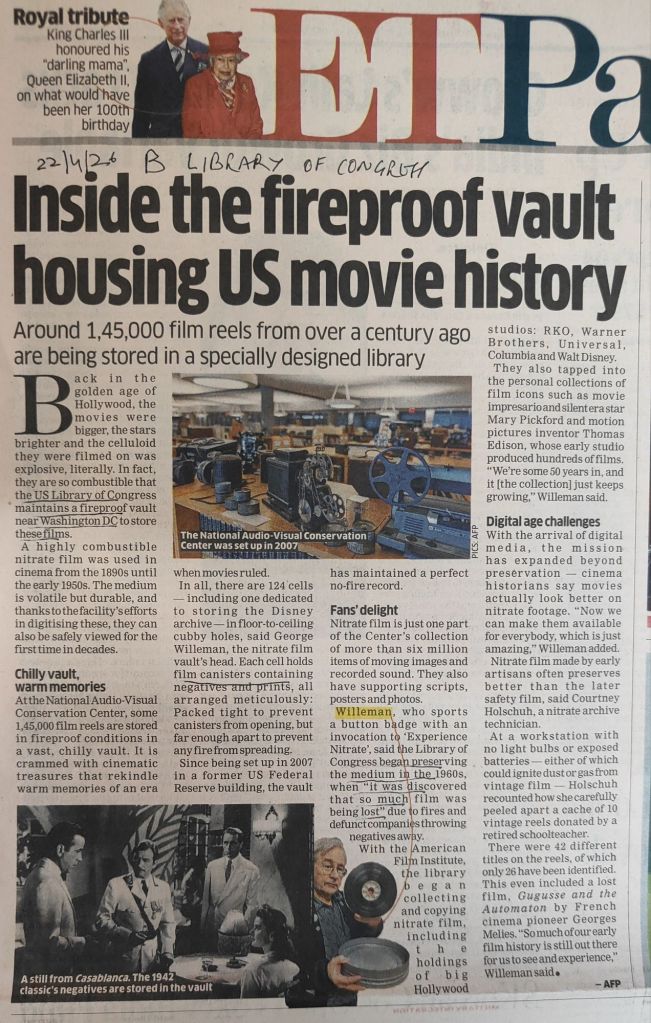
22/4/26 INSIDE THE FIREPROOF VAULT HOUSING US MOVIE HISTORY
… Around 1,45,000 film reels from over a century ago are being stored in a specially designed library…
Back in the golden age of Hollywood, the movies were bigger, the stars brighter and the celluloid they were filmed on was explosive literally. In fact, they were so combustible that the US Library of Congress maintains a fireproof vault near Washington DC to store these films.
A highly combustible nitrate film was used in cinema from the 1890s until the early 1950s. The medium is volatile but durable, and thanks to the facility’s efforts in digitising these, they can also be safely viewed for the first time in decades.
Chilly vault, warm memories
At the National Audio-Visual Conservation Center, some 1,45,000 film reels are stored in fireproof conditions in a vast, chilly vault. It is crammed with cinematic treasures that rekindle warm memories of an era when movies ruled.
In all, there are 124 cells –including one dedicated to storing the Disney archive — in floor-to-ceiling cubby holes, said George Willeman, the nitrate film vault’s head. Each cell holds film canisters containing negatives and prints, all arranged meticulously: Packed tight to prevent canisters from opening, but far enough apart to prevent any fire from spreading.
Since being set up in 2007 in a former US Federal Reserve building, the vault has maintained a perfect no-fire record.
FAN’S DELIGHT
Nitrate film is just one part of the Center’s collection of more than six million items of moving images and recorded sound. They also have supporting scripts, posters and photos.
Willeman, who sports a button badge with an invocation to ‘Experience Nitrate’, said the Library of Congress began preserving the medium in the 1960s, when “it was discovered that so much film was being lost” due to fires and defunct companies throwing negatives away.
With the American Film Institute, the library began collecting and copying nitrate film, including the holdings of big Hollywood studios: RKO, Warner Brothers, Universal, Columbia and Walt Disney.
They also tapped into the personal collections of film icons such as movie impresario and silent era star Mary Pickford and motion pictures inventor Thomas Edison, whose early studio produced hundreds of films. “We’re some 50 years in, and it (the collection) just keeps growing,” Willeman said.
DIGITAL AGE CHALLENGES
With the arrival media, the mission has expanded beyond preservation — cinema historians say movies actually look better on nitrate footage. “Now we can make them available for everybody, which is just amazing,” Willeman added.
Nitrate film made by early artisans often preserves better than the later safety film, said Courtney Holschuh, a nitrate archive technician.
At a workstation with no light bulbs or exposed batteries — either of which could ignite dust or gas from vintage film– Holschuh recounted how she carefully peeled apart a cache of a 10 vintage reels donated by a retired school teacher.
There were 42 different titles on the reels, of which only 26 have been identified. This even included a lost film, Gugusse and the Automation by French cinema pioneer Georges Melies. “So much of our early film history is still out there for us to see and experience,” Willeman said.