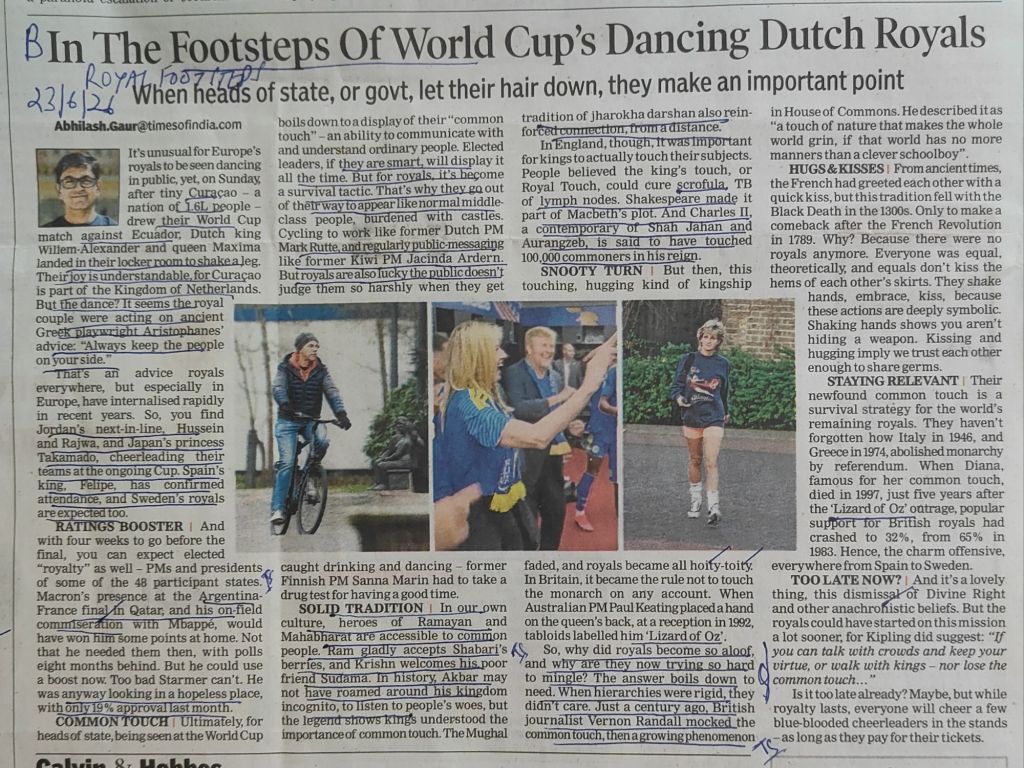
TOI 23/6/26
IN THE FOOTSTEPS OF WORLD CUP’S DANCING DUTCH ROYALS
“When heads of state, or govt, let their hair down, they make an important point”
Abhilash.Gaur@timesofindia.com
It’s unusual for Europe’s royals to be seen dancing in public, yet, on Sunday, after tiny Curacao – a nation of 1.6L people – drew their World Cup match against Ecuador, Dutch king Willem-Alexander and queen Maxima landed in their locker room to shake a leg. Their joy is understandable, for Curacao is part of the Kingdom of Netherlands. But the dance? It seems the royal couple were acting on ancient Greek playwright Aristophanes’ advice: “Always keep the people on your side.”
That’s an advice royals everywhere, but especially in Europe, have internalised rapidly in recent years. So, you find Jordan’s next-in-line, Hussein and Rajwa, and Japan’s princess Takamado, cheerleading their teams at the ongoing Cup. Spain’s king, Felipe, has confirmed attendance, and Sweden’s royals are expected too.
RATINGS BOOSTER: And with four weeks to go before the final, you can expect elected “royalty” as well – PMs and presidents of some of the 48 participant states. Macron’s presence at the Argentina-France final in Qatar, and his on-field commiseration with Mbappe, would have won him some points at home. Not that he needed them then, with polls eight months behind. But he could use a boost now. Too bad Starmer can’t. He was anyway looking in a hopeless place, with only 19% approval last month.
COMMON TOUCH: Ultimately, for heads of state, being seen at the World Cup boils down to a display of their “common touch” – an ability to communicate with and understand ordinary people. Elected leaders, if they are smart, will display it all the time. But for royals, it’s become a survival tactic. That’s why they go out of their way to appear like normal middle class people, burdened with castles. Cycling to work like former Dutch PM Mark Rutte, and regular public-messaging like former Kiwi PM Jacinda Ardern. But royals are also lucky the public doesn’t judge them so harshly when they get caught drinking and dancing – former Finnish PM Sanna Marin had to take a drug test for having a good time.
SOLID TRADITION: In our own culture, heroes of Ramayana and Mahabharat are accessible to common people. Ram gladly accepts Shabari’s berries, and Krishn welcomes his poor friend Sudama. In history, Akbar may not have roamed around his kingdom incognito, to listen to people’s woes, but the legend shows kings understood the importance of common touch. The Mughal tradition of Jharokha darshan also reinforced connection, from a distance.
In England, though, it was important for kings to actually touch their subjects. People believed the king’s touch, or Royal Touch, could cure scrofula, TB of lymph nodes. Shakespeare made it part of Macbeth’s plot. And Charles II, a contemporary of Shah Jahan and Aurangzeb, is said to have touched 100,000 commoners in his reign.
SNOOTY TURN: But then, this touching, hugging kind of kingship faded, and royals became all hoity-toity. In Britain, it became it became the rule not to touch the monarch on any account. When Australian PM Paul Keating placed a hand on the queen’s back, at a reception in 1992, tabloids labelled him ‘Lizard of Oz’.
So, why did royals become so aloof, and why are they now trying so hard to mingle? The answer boils down to need. When hierarchies were rigid, they didn’t care. Just a century ago, British journalist Vernon Randall mocked the common touch, then a growing phenomenon in House of Commons. He described it as “a touch of nature that makes the whole world grin, if that world has no more manners than a clever schoolboy”.
HUGS & KISSES: From ancient times, the French had greeted each other with a quick kiss, but this tradition fell with the Black Death in the 1300s. Only to make a comeback after the French Revolution in 1789. Why? Because there were no royals anymore. Everyone was equal, theoretically, and equals don’t kiss the hems of each other’s skirts. That shake hands, embrace, kiss, because these actions are deeply symbolic. Shaking hands shows you aren’t hiding a weapon. Kissing and hugging imply we trust each other enough to share germs.
STAYING RELEVANT: Their newfound common touch is a survival strategy for the world’s remaining royals. They haven’t forgotten how Italy in 1946, and Greece in 1974, abolished monarchy by referendum. When Diana, famous for her common touch, died in 1997, just five years after the ‘Lizard of Oz’ outrage, popular support for British royals had crashed to 32% from 65% in 1983. Hence, the charm offensive, everywhere from Spain to Sweden.
TOI LATE NOW? And it’s a lovely thing, this dismissal of Divine Right and other anachronistic beliefs. But the royals could have started on this mission a lot sooner, for Kipling did suggest: “If you can talk with crowds and keep your virtue, or walk with kings– nor lose the common touch…”
Is it too late already? Maybe, but while royalty lasts, everyone will cheer a few blue-blooded cheerleaders in the stands as long as they pay for their tickets.